


.avif)
80% of marketing automation runs on AI by 2026. According to Gartner, teams that implement AI-driven workflows see 42% more content output with 27% higher conversion rates.
But the problem isn't finding AI tools, it's building a stack that actually works together.
Most marketers add tools one at a time until they have 15+ platforms that don't talk to each other. Data lives in silos. Reports take hours to build manually. And AI that's supposed to "optimize campaigns" makes decisions on incomplete data.
This guide breaks down which AI marketing tools solve real problems in 2026, how they fit together, and, most importantly, what order to implement them so your stack actually functions as a system.
The Three-Layer Stack Architecture
Think of your AI marketing stack in layers:
Layer 1: Data Foundation
Connect fragmented data sources (ad platforms, CRMs, analytics) into unified destinations. Without this, tools in Layer 2 and 3 make decisions on bad data.
Layer 2: Marketing Automation
Email sequences, lead nurturing, campaign workflows, cross-channel orchestration.
Layer 3: AI Optimization
Bid optimization, content generation, predictive analytics, performance analysis.
McKinsey research shows companies with poor data quality lose $12.9 million annually. You can't skip Layer 1 and expect AI to magically fix reporting problems.
Layer 1: Data Integration (Start Here)
Why Data Integration Comes First
Before deploying AI to optimize bids or generate reports, you need clean data flowing automatically from marketing platforms.
The manual export problem: Teams still download CSVs from Google Ads, Meta, TikTok, and LinkedIn, then copy-paste into spreadsheets. This breaks the moment you scale past 2-3 platforms.
What automated data integration does:
- Pulls data from 50+ marketing platforms daily
- Standardizes metrics across platforms (ROAS, CPA, conversions)
- Historical backfilling (no more "we launched this campaign 6 months ago but don't have the data")
- Enables cross-platform reporting (compare Google Ads vs Meta vs TikTok in one dashboard)
Dataslayer
Connects Google Ads, Meta Ads, TikTok Ads, LinkedIn Ads, GA4, Search Console, and 50+ marketing data sources to Google Sheets, Looker Studio, BigQuery, and data warehouses.
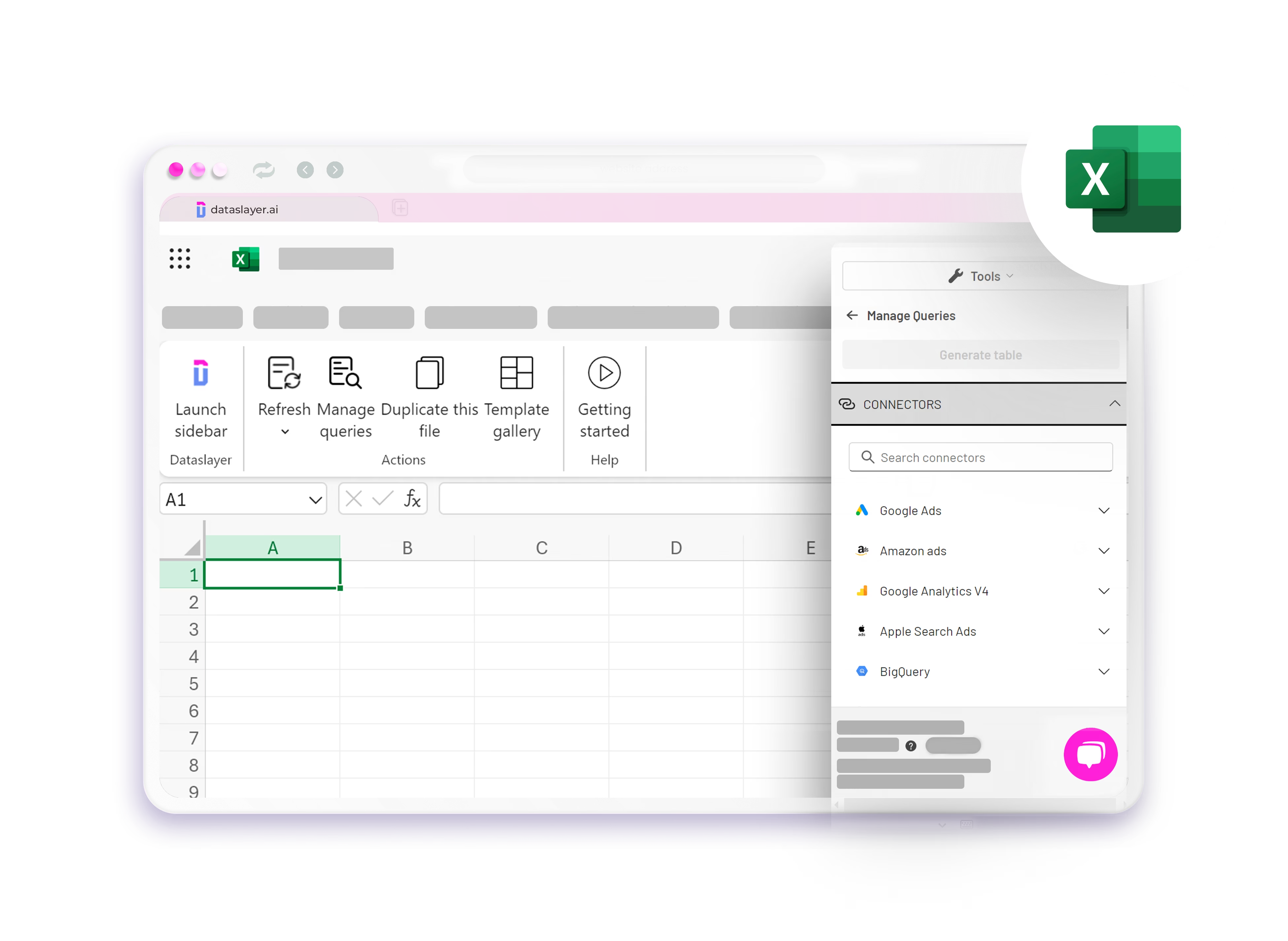
Key capabilities:
- Automated daily refreshes (no more manual exports)
- Historical data backfilling (retrieve campaign data from 2+ years ago)
- Custom metrics and calculated fields
- Cross-platform data blending
- MCP integration for conversational data analysis with Claude
Real use case: E-commerce brand running Google Ads, Meta, and TikTok automated their Looker Studio dashboard. Updates daily at 6 AM instead of 10 hours/week on manual CSV exports. ROAS visibility across all platforms in one view.
Zapier
Connects 8,000+ apps with workflow automation logic.
Best for: Simple triggers like "when form submitted, add to CRM and send Slack notification."
Limitation: Handles actions well, but not complex data transformation or large-scale marketing data aggregation.
Pricing: Free tier available, paid from $29.99/month.
Source: Zapier official site
Layer 2: Marketing Automation & CRM
HubSpot Marketing Hub
All-in-one platform with Breeze AI for campaign creation, lead scoring, and content generation.
Best for: B2B teams wanting integrated marketing and sales. Free CRM makes it accessible for small teams.
Breeze AI features:
- AI-assisted email campaigns
- Predictive lead scoring
- Brand voice content generation
Pricing: Free CRM, Marketing Hub from $15/user/month (Starter), $800/month (Professional with Breeze AI).
Why teams choose it: Eliminates tool sprawl. Email, CRM, landing pages, and analytics in one ecosystem.
Source: HubSpot official site
Klaviyo
E-commerce-focused email and SMS automation.
Why e-commerce brands use it: Native Shopify integration, predictive CLV analytics, AI product recommendations in emails.
Pricing: Free up to 250 contacts, scales with volume.
Source: Klaviyo official site
Layer 3: AI Ad Optimization
Smartly.io
Enterprise AI platform for Meta, TikTok, Pinterest, and Snap.
Key capabilities:
- Automated campaign scaling
- Creative testing with AI recommendations
- Real-time budget allocation
- Brand safety controls
Best for: Brands spending $50k+/month on paid social managing hundreds of ad variations.
Pricing: Custom enterprise (typically $2,500+/month minimum).
Source: Smartly.io official site
Madgicx
AI-powered Meta Ads automation platform.
AI Bidding (exclusive feature): Real-time bid adjustments based on auction dynamics and target ROAS/CPA.
AI Marketer: Daily account audits with one-click optimizations. "ROAS dropped because audience fatigue in Lookalike 1%. Pause it?"
Best for: E-commerce spending $5k+/month on Meta.
Pricing: From $44/month for <$2,500 spend, scales with budget.
Limitation: Only optimizes Meta. Reports from TikTok/Google but can't optimize them.
Source: Madgicx official site
AdCreative.ai
AI creative generation for static ads across Meta, Google, LinkedIn.
Best for: High-volume creative testing. Generate dozens of variations fast.
Pricing: From $29/month.
Source: AdCreative.ai official site
Analytics & Visualization
Polymer
No-code BI platform with AI that auto-analyzes spreadsheets, CSVs, APIs.
PolyAI feature: Conversational analytics. Ask "Show me best-performing ad creative this week" instead of building charts manually.
Best for: Marketing/sales/ops teams needing dashboards without SQL knowledge.
Pricing: 14-day trial, paid from ~$50/month.
Integration note: Works downstream of Dataslayer. Pull marketing data via Dataslayer, visualize in Polymer.
Source: Polymer official site
Looker (Google Cloud)
Enterprise BI with AI-powered insights.
Best for: Large teams with data warehouses (BigQuery, Snowflake) needing role-based analytics.
Pricing: Contact Google Cloud.
Source: Looker official site

Content Creation
Jasper AI
Evolved from copywriting tool to full Content Automation platform in 2026.
New features:
- Jasper Grid: Multi-channel workflows
- Jasper Studio: Team collaboration
- No-code AI App Builder
- API access
Best for: Marketing teams creating brand-consistent content at scale.
Pricing: Creator $39/month, Pro $59/month.
Source: Jasper official site
Grammarly GO
Real-time writing + AI rewriting. Beyond grammar to tone and structure transformation.
Best for: Polishing copy across emails, landing pages, blogs. Works everywhere (browser extension).
Pricing: Free tier, Premium $12/month.
Source: Grammarly official site
Descript
AI video editing. Edit video by editing transcript text. Video changes automatically.
Overdub: Clone your voice to fix mistakes without re-recording.
Best for: Video marketers creating tutorials, demos, social content.
Pricing: Free tier, paid from $12/month.
Source: Descript official site
How to Build Your Stack (Step-by-Step)
Step 1: Data Integration
Set up automated flows from ad platforms, analytics, CRM to reporting destination.
Example with Dataslayer:
- Google Ads → BigQuery (daily 6 AM)
- Meta Ads → Google Sheets (every 4 hours)
- GA4 + Search Console → Looker Studio (daily)
- TikTok Ads → BigQuery (daily)
Agency example: Marketing agency managing 12 client accounts automated all reporting with Dataslayer multi-account setup. Each client gets branded Looker Studio dashboard updating automatically. Time saved: 25 hours/week across team.
Step 2: Marketing Automation
Choose based on business model:
- B2B with longer sales cycles: HubSpot
- E-commerce: Klaviyo
- Budget-conscious with complex workflows: ActiveCampaign
Step 3: Ad Optimization
- $50k+/month across platforms: Smartly.io
- Meta focus, $5k+/month: Madgicx
- High-volume creative testing: AdCreative.ai
Step 4: Analytics
- No-code dashboards: Polymer
- Enterprise data governance: Looker
Step 5: Content Tools
Add content tools once you know what performs (from Layer 4 analytics).
- Multi-channel content at scale: Jasper AI
- Polish existing copy: Grammarly GO
- Video content: Descript
Tool Comparison Table
Common Stack Mistakes
Mistake 1: Adding Tools Before Fixing Data
Problem: Deploy Madgicx or Polymer but feed them inconsistent data from manual exports.
Fix: Automate data integration first. A €49/month data tool saves 10+ hours weekly and prevents bad decisions.
Mistake 2: Tools That Don't Integrate
Problem: CRM doesn't talk to ad platform. Analytics can't pull email data. Manually connecting dots.
Fix: Map your stack before buying. Check native integrations or use middleware (Zapier for actions, Dataslayer for data).
Mistake 3: No Layer 1 Foundation
Problem: Jump to AI optimization without unified data infrastructure.
Fix: Build foundation-up: Data Integration → Automation → Optimization.
Real Stack Examples
E-commerce ($50k/month ad spend)
Layer 1: Dataslayer + Zapier
Layer 2: Klaviyo
Layer 3: Madgicx + Jasper AI
Analytics: Polymer
Why it works: Unified data from Shopify, ad platforms, email flows into Klaviyo and Polymer. Madgicx optimizes biggest channel (Meta). Jasper scales content.
B2B SaaS Startup
Layer 1: Dataslayer
Layer 2: HubSpot
Layer 3: AdCreative.ai
Analytics: HubSpot native + Looker Studio
Why it works: Lean stack. HubSpot handles most automation. Dataslayer fills gaps HubSpot doesn't cover (TikTok, GA4 blends).
Marketing Agency (10+ clients)
Layer 1: Dataslayer multi-account + Zapier
Layer 2: HubSpot
Layer 3: Smartly.io
Analytics: Polymer
Why it works: Dataslayer manages data for 10+ accounts. Smartly scales ad management. Polymer creates white-labeled dashboards.
Key 2026 Trends
Autonomous Orchestration
Marketing automation moving from scheduled workflows to self-optimizing systems that plan, execute, adjust campaigns real-time.
Example: Instead of "send email when ebook download," systems predict optimal message, channel, timing without manual rules.
Privacy-First Automation
iOS changes and cookie deprecation make compliant automation a competitive advantage. Tools using first-party data and server-side tracking perform better.
AI Integration as Baseline
Having "AI features" isn't a differentiator in 2026, it's expected. The question is how good the AI integration is.
Watch for: Tools with Model Context Protocol (MCP) support for conversational data analysis.
Start With the Foundation
Before deploying AI to optimize bids or generate content, you need unified marketing data flowing automatically.
Truth: Smartly, Jasper, and Polymer are powerful, but useless if fed inconsistent data from manual exports.
Your next steps:
- Audit current data flow: Still exporting CSVs manually? Reporting delayed 24+ hours?
- Automate data integration: Connect ad platforms, analytics, CRM to unified destinations. This is Layer 1, the foundation everything else depends on.
- Layer in automation and optimization: Once data flows cleanly, add tools that depend on it (HubSpot, Madgicx, Polymer).



