


.avif)
Google Ads added a transparency feature in November 2025 that solves a common reconciliation headache: a way to see actual conversion value before all the automated adjustments kick in.
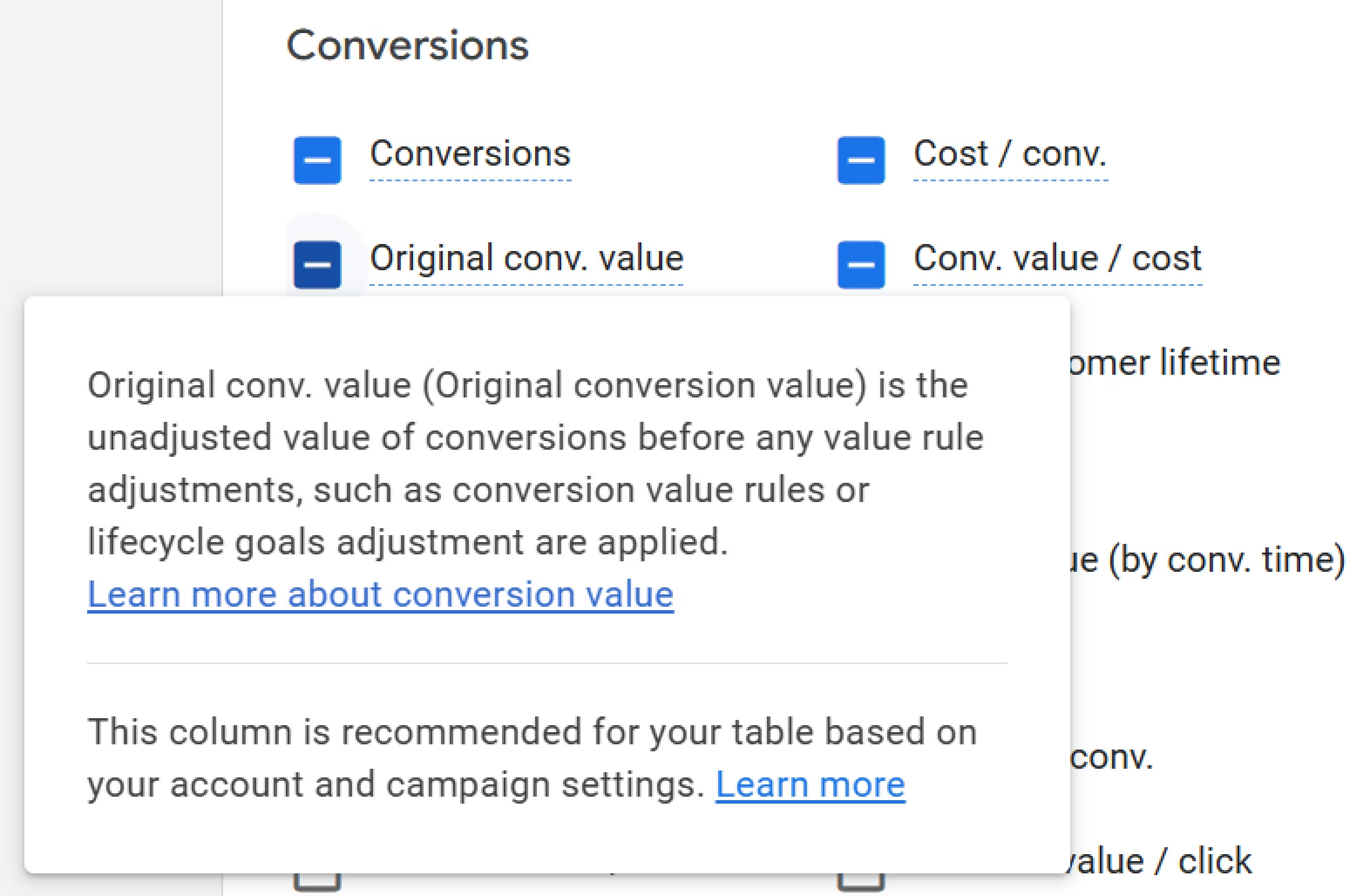
The Original Conversion Value metric strips away value rule multipliers, New Customer Acquisition bonuses, and lifecycle goal adjustments to show the raw revenue your campaigns generated. Spotted by Google Ads specialist Thomas Eccel, it wasn't announced, it just appeared in accounts.
When your ROAS jumps 30% overnight, you can now instantly tell if it's from better performance or just value rules inflating your numbers.
The Transparency Problem This Solves
Your Google Ads dashboard shows $50,000 in conversion value. Your Shopify backend shows $38,000 in actual revenue. Which number is right?
Before this metric, you'd spend time reconciling the gap or building custom reports with segmentation. The $12,000 difference could be from New Customer Acquisition bonuses adding $25 per first-time buyer, value rules multiplying California customers by 1.5x, or both.
Smart Bidding optimizes toward the adjusted $50,000 figure because that reflects your business priorities. But when reporting to stakeholders or calculating actual ROAS, you need the $38,000 baseline. Now both numbers are visible side-by-side.
This is especially useful for D2C brands, SaaS companies tracking customer segments, and agencies who need to reconcile Google Ads performance with backend revenue.
How to Find It
Google didn't document this update. In your Google Ads account:
- Go to any campaign view
- Click the Columns icon
- Expand Conversions
- Check Original Conversion Value
- Place it next to Conversion Value for easy comparison
When This Actually Matters
You need this if:
- Running campaigns with conversion value rules
- Using New Customer Acquisition or lifecycle goals
- Running Performance Max with Target ROAS
- Reporting actual revenue to clients or finance teams
You don't need this if:
- Using basic conversion tracking without adjustments (both metrics will match)
- Not concerned with backend revenue reconciliation
- Already comfortable with value rule reporting
Paid media expert Léo Provost called it useful "when you leverage new client driven campaigns with an incremental conversion value on new customer." But Yacine El Hichri noted that for accounts without value rules, "the original conversion value will match the standard conversion value metric...pretty much useless to be honest."
3 Practical Applications
Catch declining performance before it kills your budget
Your weekly reports show Conversion Value steady at $100,000. But Original Conversion Value dropped from $95,000 to $88,000 to $81,000. Actual revenue fell 15% while adjustments masked it. Without this metric, you'd keep spending normally instead of investigating what changed.
Compare campaigns fairly
Two campaigns both show $50,000 in Conversion Value. Original Conversion Value reveals Campaign A generated $27,800 (1.8x adjustment) while Campaign B generated $45,500 (1.1x adjustment). Campaign B drives 64% more real revenue despite identical adjusted figures.
Validate Smart Bidding targets
A brand running 400% Target ROAS saw $45,000 Conversion Value (450% ROAS, looks great!) but only $35,000 Original Conversion Value (350% actual ROAS, below target). They nearly scaled budget based on inflated performance.
What the Gap Tells You
Calculate the ratio: Conversion Value ÷ Original Conversion Value
- 1.0 = No adjustments active
- 1.2-1.5 = Moderate adjustments (typical for geo or device rules)
- 1.8+ = Heavy value inflation
Growing gap over time means either you're attracting more high-value segments your rules target, or actual performance is declining while adjustments compensate. Investigate which.
Shrinking gap suggests fewer new customers, less traffic from premium locations, or audience drift.
Reporting Across Multiple Platforms
If you're consolidating data from Google Ads, Facebook Ads, and other platforms into dashboards, both Original and adjusted Conversion Value are useful. Facebook and TikTok don't have equivalent adjustment layers, so when comparing cross-platform Google Ads metrics, Original Conversion Value gives you apples-to-apples revenue comparison.
Most automation tools that sync Google Ads to Google Sheets, Looker Studio, or BigQuery have added this field. If you're manually exporting data, add both columns.
FAQ
When did this launch?
November 2025. Google didn't announce it, Thomas Eccel spotted it and shared on LinkedIn.
Will it change my Smart Bidding?
No. Smart Bidding continues optimizing toward adjusted Conversion Value. This only improves reporting transparency.
Why are my numbers different?
You're using conversion value rules or lifecycle goals. The ratio shows adjustment magnitude, 1.3 means rules add 30% to baseline revenue.
Should I add this column?
Only if you use value adjustments. Otherwise it's redundant clutter.
Is it available in the API?
Yes, for programmatic reporting.
The Bottom Line
This isn't revolutionary, but if you're running campaigns with value rules or NCA goals, the 30-second setup gives you permanent clarity on whether performance changes are real or adjustment-driven.
For agencies, it eliminates the "why doesn't this match our backend revenue?" reconciliation conversation.
If you're not using value adjustments yet, add the column anyway, it's there when you need it and doesn't hurt anything.
One of those rare Google updates that actually simplified reporting.



