


On May 20, 2026, Google held Marketing Live and used the keynote to make the same point under seven different banners: Gemini is now the operating system of Google Ads. The presentation moved through new AI-native ad placements, a creative production stack rebuilt around natural-language briefs, a chat agent for lead capture, a conversational interface to query your own Google data, and a marketing mix modeling capability shipped directly inside Analytics 360. Every announcement assumed AI is the default surface, not a feature added later.
For marketers, this means real changes to how creative gets produced, where ads appear, how leads get captured, and how performance gets analyzed inside Google's stack. This guide covers the seven updates that actually require you to do something this quarter, what the action looks like for each, and the one question Marketing Live 2026 did not answer, which still sits on your desk regardless of how many Gemini features ship.
This is not a launch announcement read-through. It is the operator's version: what changed, who is affected, what to do this week, this month, and this quarter.
1. Asset Studio with Gemini Omni: creative becomes a natural-language brief

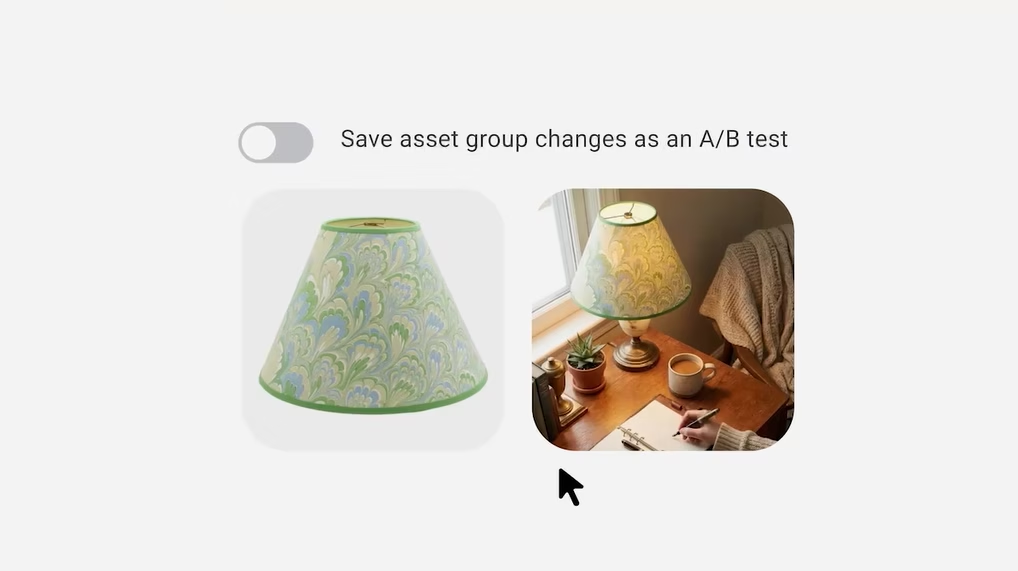
Asset Studio got a major upgrade powered by Gemini Omni, Google's multimodal model that handles image, video, and copy generation from the same brief. The promise: instead of producing 30 creative variants in a separate tool and uploading them, you describe the campaign intent and the studio generates the variants inside the ad workflow. Google announced a staged rollout starting summer 2026.
What this changes for marketers:
- Creative production cycles compress. A typical Meta or Google variant batch that took two days through a design agency now takes hours through a prompt-driven brief. The bottleneck shifts from production capacity to brief quality.
- Brief writing becomes the actual marketing skill. The teams that win on AI-generated creative are the teams that write the most precise briefs: clear audience, clear angle, clear objection handled, clear call to action.
- QA goes up, volume of human-made creative goes down. The work shifts from "make 30 variants" to "review 30 generated variants and kill the ones that miss brand or compliance." The skill you hire for changes.
What to do this quarter: rebuild your creative brief template around AI generation. The fields that matter most: target audience specificity, the single dominant emotion or objection, the call to action, brand voice anchors with examples, and what is off-limits. A vague brief with Gemini produces vague creative; a sharp brief produces material you can ship.
2. Ads in AI Mode: new placements inside Google's conversational search
Google formalized new ad surfaces that live inside AI Mode, its conversational search experience. The placements announced at GML 2026 include Ads in AI Mode (sponsored responses inline as users ask follow-up questions) and Direct Offers (product or service offers attached to AI-generated answers when the intent matches a commercial query).
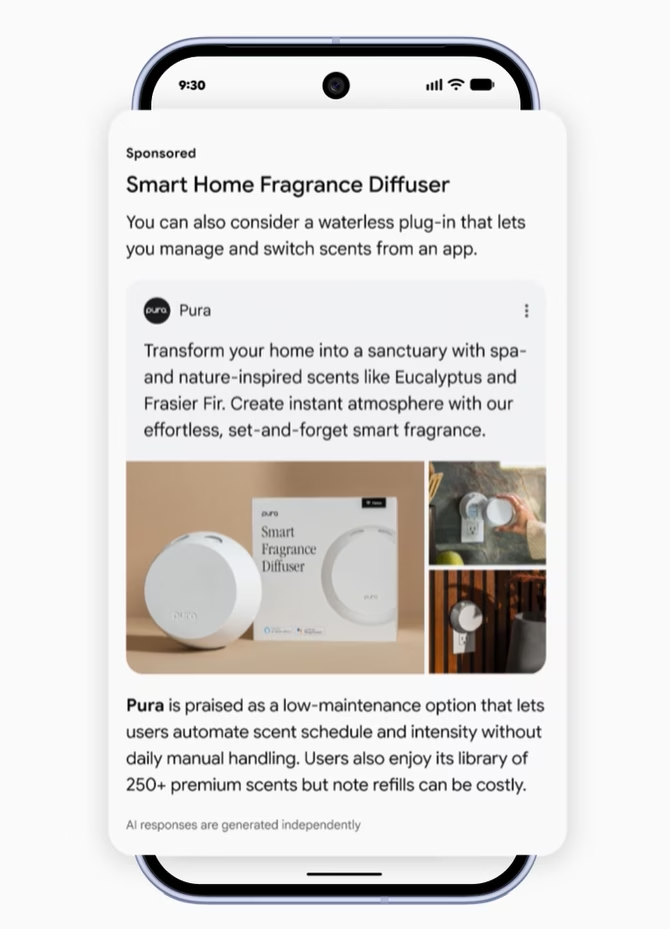
What this changes for marketers:
- Search intent changes shape. The user is no longer typing a query and choosing among ten blue links. They are having a conversation and forming a decision in real time. The ad that wins is the one that fits the next logical step in that conversation, not the one with the highest match score to a keyword.
- Keyword targeting matters less, intent targeting matters more. Google has been moving this direction for years (broad match, smart bidding). AI Mode placements accelerate it. Audience signals, page context, conversion data, and creative quality become bigger levers than keyword precision.
- Reporting gets noisier in the short term. Impressions in AI Mode behave differently from traditional SERP impressions. Compare year-over-year only after you have clean 60 to 90 days of post-launch data; before that, anomalies are placement-mix changes, not performance changes.
What to do this quarter: opt into AI Mode placements in test campaigns, run them in isolation (separate campaign or asset group) so you can measure them cleanly, and resist the temptation to compare AI Mode metrics directly to traditional search metrics. The user behavior underneath is different and warrants its own baseline.
3. AI-powered Shopping ads with auto-generated explainers
Shopping ads got an AI layer that generates a short product explainer alongside the standard image, title, and price. For categories where the buyer needs context (technical products, multi-spec items, considered purchases), the explainer can summarize fit, use case, or why this product matches the search intent.
What this changes for marketers:
- Product feed quality matters more than ever. The auto-explainer pulls from your feed attributes, your product page, and review data. Sparse feeds produce thin explainers. Rich feeds produce explainers that convert.
- Title gymnastics matters less. The keyword-stuffed product titles that used to win Shopping placements look worse next to an AI-generated explainer that actually describes the product. Clean titles plus rich attributes become the better combination.
- Long-tail discoverability improves for niche products. A specialty product that lost on title-match keywords can win on intent-match if the explainer surfaces the fit. Categories with strong product-market fit but weak SEO see the biggest lift.
What to do this quarter: audit your product feed for attribute completeness (material, dimensions, use case, compatibility, key benefits). Run a feed enhancement pass on your top 50 SKUs before opting into AI explainers, because the AI is downstream of your feed quality.
4. Business Agent for Leads: chat replaces the lead form
Business Agent is a conversational lead capture experience that replaces (or supplements) the traditional lead form. A potential customer clicks an ad, lands in a chat experience powered by Gemini that qualifies them, answers questions about your offering, and books the next step (demo, call, signup) inside the conversation.
What this changes for marketers:
- Lead quality definition shifts. The chat agent can ask qualification questions a form cannot. A "lead" from Business Agent comes pre-qualified by 3 to 5 conversational exchanges, which is closer to what an SDR would do on first contact.
- The handoff to CRM changes. A traditional form pushes a lead row to your CRM. Business Agent pushes a lead row plus a conversation transcript and a Gemini-extracted summary of the qualifying signals. SDRs need to be trained to read the transcript before the first outreach.
- Conversation design becomes a marketing job. The flow that converts is not the same as a landing page copy and not the same as an SDR script. It is a hybrid that marketing owns but sales informs.
What to do this quarter: if you run B2B lead-gen, pilot Business Agent on one or two campaigns and measure two things: pre-qualified lead rate (the percentage of conversations that produce a qualified lead) and SDR feedback on lead quality. Train your SDRs to open every Business Agent lead with the transcript loaded.
See Google performance next to everything else
GML 2026 makes Google's data easier to query, but only inside Google. Dataslayer pulls Google Ads, GA4, and Search Console alongside Meta, LinkedIn, TikTok, HubSpot, Stripe, and 50+ other sources into the same workbook so the cross-platform questions also have an answer.
Try Dataslayer Free5. Ask Advisor: a conversational layer over Google's marketing data
Ask Advisor is a natural-language interface that lets you query Google Ads, Google Analytics 4, Merchant Center, and Google Marketing Platform from the same prompt. Questions like "which campaigns underperformed last week and what changed" get answered without exporting data or stitching across UIs. Ask Advisor launches in beta, English-only at first, with additional languages and surfaces rolling out through the rest of 2026.
What this changes for marketers:
- Time-to-insight inside Google data drops significantly. Questions that used to require an analyst with SQL or a Looker Studio rebuild now get answered in seconds inside the prompt.
- Junior team members get access to questions previously held by senior analysts. An account manager who could not write SQL can now ask the same questions a data analyst would ask.
- The scope of the answer is Google-only by design. Ask Advisor sees Ads, Analytics, Merchant Center, GMP. It does not see Meta, LinkedIn, TikTok, HubSpot, Stripe, Klaviyo, or your CRM. The questions that span those sources still need a different layer. The cross-platform equivalent of Ask Advisor, natural-language queries that include Meta, LinkedIn, TikTok, your CRM, and your ecommerce data alongside Google, is what Dataslayer GPT was built for.
What to do this quarter: enable Ask Advisor for your team when it reaches your account, document the question types it handles well (it is excellent at Google-data diagnosis, weaker on cross-platform attribution), and establish team norms for when to use it versus when to escalate to a manual cross-platform query.
6. Meridian MMM gets a deeper GA4 integration
Meridian is Google's open-source marketing mix modeling library, available on GitHub since 2024. At GML 2026 Google announced a deeper GA4 and Analytics 360 integration so customers can feed their analytics data into Meridian with less manual engineering. The output is the standard MMM deliverable: spend allocation recommendations across channels, ROI estimates, and saturation curves.
What this changes for marketers:
- MMM stops being a once-a-year deliverable. An MMM that you can re-run as your data changes shifts MMM from a quarterly executive deck to a near-continuous planning input.
- The data quality bottleneck moves to the front. Meridian works well when you feed it complete spend data across all your paid channels, plus seasonality and macro signals. Garbage in, garbage out applies more visibly when the model is wired into your reporting tool.
- The non-Google data piece is yours to bring. Meridian does not magically know what you spent on Meta, LinkedIn, TikTok, or Microsoft Ads. You still have to land that data into GA4, Analytics 360, or a connected BigQuery dataset on a reliable schedule. This is the operational layer that determines whether your MMM is useful or directionally wrong.
- A managed MMM is the alternative if you do not want to wait for the rollout. If you want to run MMM today without waiting for the Meridian-in-GA4 rollout or stitching non-Google spend manually, Morpheus delivers the same modeling approach as a managed product, with cross-channel spend already piped in through the same connector layer you use for the rest of your reporting.
What to do this quarter: audit your non-Google spend pipelines. If your Meta, LinkedIn, TikTok, and Microsoft Ads spend is not currently landing in GA4 or a connected BigQuery dataset on a reliable schedule, fix that before you run your first Meridian model. The output will only be as good as the spend coverage.
7. Qualified Future Conversions: predicted-value attribution
Qualified Future Conversions (QFCs) is a new Gemini-powered metric that estimates the future revenue value of a current ad click by analyzing patterns like subsequent brand search behavior, repeat visits, and conversion paths from similar historical users. The idea: upper-funnel campaigns that build brand familiarity get credit for the conversions they enable downstream, not just direct conversions. Google announced a restricted pilot during 2026, with broader beta access expected later in the year.
What this changes for marketers:
- Brand spend gets a defensible attribution number. The chronic problem with upper-funnel campaigns has been getting credit for indirect impact. QFCs provide a Google-modeled number that can be reported alongside last-click and assisted conversion data.
- Smart Bidding can optimize toward predicted value, not just immediate value. Once QFCs are in Smart Bidding signals, campaigns that drive future conversions get bid-adjusted upward even if their direct conversion rate looks weak. This is potentially the most impactful change for B2B and considered-purchase advertisers.
- The prediction is Google-only. QFCs predict the future value of Google clicks based on Google-observable signals (brand search, repeat visits to Google-tracked properties). They do not predict the multi-touch journey across Meta, LinkedIn, organic, and email. For brands where the multi-touch journey is the reality, QFCs are a partial picture.
What to do this quarter: request access to the QFC pilot if you run brand or upper-funnel Google Ads campaigns and have a mature attribution stack. Treat QFC numbers as one input alongside your existing model rather than a replacement.
The one question Marketing Live 2026 did not answer
The seven updates above make Google's data smarter, faster to query, easier to model, and predictive of future value. They are real improvements for the work that happens inside Google's stack.
None of them answer the question every marketer with multi-channel spend already has: how do my Google ads compare to my Meta ads, my LinkedIn ads, my TikTok ads, and my organic, all in the same view, joined to my CRM and to my subscription data, refreshed on the cadence I need?
Ask Advisor sees Google data. Meridian needs you to land non-Google spend yourself. QFCs predict Google click value. Asset Studio generates creative for Google placements. Google made the experience inside its own stack a lot better. The cross-platform layer is still yours to build.
For teams that live mostly inside Google (high-spend Search advertisers, Shopping merchants, GA360 customers with little non-Google spend), GML 2026 is a meaningful productivity upgrade. For teams that run real multi-channel programs (most B2B SaaS, most DTC, most agencies), the new Google features sit on top of a cross-platform reporting layer that you still have to maintain yourself.
Action items by team type
In-house performance marketing teams: opt into AI Mode placements in test campaigns, enable Ask Advisor when it reaches your account, audit your product feeds before turning on AI explainers, and request access to the QFC pilot if you have any upper-funnel spend.
Agencies: the creative production speed-up from Asset Studio is the biggest near-term margin lever. Train the production team on prompt-driven briefs. The reporting speed-up from Ask Advisor compounds across clients, so build it into your standard weekly workflow.
Ecommerce and DTC: the feed quality work that AI Shopping demands is the biggest lever. Prioritize attribute completeness for top SKUs first, then expand. The Meridian-in-GA360 capability is most valuable for brands at the spend tier where MMM was previously cost-justified through external consulting.
B2B SaaS: Business Agent for Leads deserves a pilot if your current lead form converts at standard rates and you can handle a different lead-quality distribution. QFCs matter more here than for DTC because the sales cycle is longer and traditional attribution loses signal across that timeline.
Anyone with cross-platform spend: the work to consolidate non-Google data into a place where it can be queried together has not gotten less important. Make the cross-platform layer first; layer Google's AI on top of complete data, not partial data.
FAQ
When do these features become available?
Google announced rollouts staged through the rest of 2026. Asset Studio with Gemini Omni begins rolling out summer 2026, Ask Advisor launches in beta (English-only at first), AI Mode placements expand region by region, Business Agent for Leads is in pilot for select advertisers, and Qualified Future Conversions are in restricted pilot with broader beta expected later in 2026. Check the official Google Ads Help Center for your account's specific availability.
Does Ask Advisor work with Meta Ads or LinkedIn Ads data?
No. Ask Advisor is scoped to Google Ads, Google Analytics 4, Merchant Center, and Google Marketing Platform products. Questions that involve non-Google sources need to be answered with a different tool, typically a cross-platform reporting layer that pulls Google plus Meta plus LinkedIn plus your CRM into the same workbook.
How is the new Meridian integration different from running Meridian as open source?
The model logic is the same; Meridian is open source either way. The difference is integration depth: inside GA4 and Analytics 360, the data already there (web analytics, Google Ads spend, conversions) feeds the model with less manual wiring. You still have to bring in non-Google spend data yourself. The integration saves engineering work but does not solve the data coverage problem. A third option some teams pick is a managed MMM product like Dataslayer's Morpheus, which runs the modeling layer on top of cross-platform spend that is already consolidated through connectors. The trade-off there is less customization than open-source Meridian gives you, but no engineering work to wire the data in.
What changes about creative production budgets?
If your creative production was a major line item, expect that budget to shift rather than shrink. Less spend on producing 30 variants from scratch, more spend on brand voice work, brief design, quality review of AI-generated assets, and the design system that defines what acceptable AI output looks like for your brand.
Should I pause my current attribution work to wait for QFCs?
No. QFCs are an additional signal, not a replacement for your existing attribution model. Treat them as one input alongside last-click, assisted conversions, and any third-party MTA or MMM work you do. Teams that get the most out of QFCs are the ones whose attribution stack is already mature enough to add another lens without confusion.
How should agencies talk to clients about GML 2026?
Lead with the productivity gains (faster creative production, faster reporting), be honest about what Google's tools do and do not see (Ask Advisor is Google-only), and frame the cross-platform reporting layer as the work that connects Google's improvements to the actual business.
Conclusion
Marketing Live 2026 was an unusually substantive event. The seven updates above each ship real new capability and each require real new work to get right. Asset Studio changes creative production. AI Mode placements change where ads appear. Business Agent changes how leads enter the funnel. Ask Advisor changes how Google data gets queried. Meridian and QFCs change how marketing mix and attribution get measured. None of these are vaporware.
The thing to remember: every one of these improvements happens inside Google's data and Google's surfaces. The cross-platform work, the work of seeing your Google ads alongside your Meta and LinkedIn and TikTok and email and CRM in one view, did not get easier. It got more visibly important.
Start a free Dataslayer trial to bring Google Ads, GA4, Search Console, Meta, LinkedIn, TikTok, HubSpot, Stripe, and 50+ other marketing sources into one workbook, so the cross-platform questions Google's new tools cannot answer have a place to live.



