



When someone asks Meta AI "best coffee maker under $100," they'll start seeing coffee maker ads across Facebook and Instagram. That's been true since December 16, 2025, when Meta activated AI conversation targeting for over 1 billion monthly users.
The technology works. Meta's Advantage+ AI advertising reached a $60 billion annual revenue run rate in Q3 2025, with ad revenue growing 26% year-over-year to $50.1 billion in a single quarter.
But the problem is that you can't see any of it in your reporting. AI conversation data doesn't appear as a breakdown in Ads Manager. It's not accessible via API. You just see better CPAs and higher CTRs without knowing why.
What Changed on December 16
Meta announced in October 2025 that interactions with Meta AI would become ad targeting signals. This includes:
- Text conversations with Meta AI chatbot
- Voice queries through Ray-Ban Meta glasses
- Image generation via Imagine
- Video interactions with Vibes feed
The rollout excludes the EU, UK, and South Korea due to GDPR and similar privacy laws. Only conversations after December 16 count, past interactions remain unused.
Meta explicitly excludes certain topics from ad targeting: religious views, sexual orientation, political beliefs, health conditions, racial or ethnic origin, philosophical beliefs, and trade union membership.
In our previous analysis of this change, we covered what data Meta collects and how it affects ad strategy. This article focuses on the measurement challenge.
The Numbers Behind Meta's AI Infrastructure
The $60 billion figure represents Meta's fastest-growing revenue stream. For context, Microsoft's Azure AI revenue was estimated at $20-26 billion over the same period, making Meta's AI advertising infrastructure the second-largest AI revenue source after Nvidia.
Meta's Andromeda algorithm, introduced in late 2024, now controls targeting. Where advertisers previously selected audiences through interest and behavior targeting, Andromeda uses creative content to determine who sees ads. In Q3 2025, Meta improved Andromeda's performance by 14% on Facebook by combining retrieval and ranking models.
The Attribution Gap
Someone asks Meta AI: "What running shoes are good for flat feet?"
Meta's algorithm learns:
- Active purchase intent for athletic footwear
- Specific need (arch support)
- Price sensitivity (if they mention budget)
- Timeline (if they say "need for next month")
Your sporting goods ad appears 20 minutes later. They click. They buy.
What you see in Ads Manager: 1 conversion, $32 CPA
What you don't see:
- Did AI conversation data find this customer?
- How many of today's conversions came from AI targeting vs traditional signals?
- Which conversation topics drive purchases?
- Is this month's 18% CPA improvement from AI or seasonal trends?
Meta has no plans to add AI conversation data as a separate breakdown. The data feeds the algorithm, but remains invisible.
How This Compares to Other Black Boxes
Google Performance Max (2021)
Combines Search, Display, YouTube, Gmail, Discover with no placement-level breakdown or keyword data.
TikTok Smart+ (2025)
Automated creative and targeting with limited performance visibility. October 2025 update added module-by-module control.
Amazon Sponsored Products
Search term reports sample only 25% of clicks with no demographic data.
The pattern: as AI automation improves performance, transparency decreases. Meta AI conversations represent the most intimate data source yet and the least visible.
Early Performance Data
Meta's December 2025 Partnership Ads update shows what AI-powered targeting can achieve:
- 19% lower cost per acquisition vs standard ads
- 13% higher click-through rates
- 71% of consumers purchase within days of seeing creator content
UK wellness brand Purdy & Figg saw +555% revenue growth over 60 days using creator partnership ads with lower CPA than business-as-usual campaigns.
A fashion ecommerce company using Meta's value optimization achieved 5x higher incremental ROAS compared to CPA-focused campaigns.
These results prove the technology works. The question is whether you can replicate it without understanding which variables drive success.
Building Independent Attribution
The solution isn't abandoning Meta. It's creating your own measurement layer.
Document Your Baseline
Before AI targeting impacts your campaigns, capture current performance:
- Cost per click by campaign (daily)
- Conversion rate by landing page
- Cost per acquisition by product
- Click-through rate by placement
- Time to conversion
When Meta's AI finds better audiences through conversation data, you'll see sudden improvements you didn't cause. That's your signal.
Implement Customer-Side Tracking
Platform pixels only show what happened. Customer-side tracking shows who and how.
UTM parameters:
utm_source=meta
utm_medium=cpc
utm_campaign=holiday_2026
utm_content=ai_test_1
Consistent naming lets you track performance in Google Analytics independent of Meta's reporting.
Server-side tracking:Send conversion events from your server, not just browser. This captures users with ad blockers, iOS privacy restrictions, and cross-device behavior. Meta's Conversions API supports this.
Create a Unified View
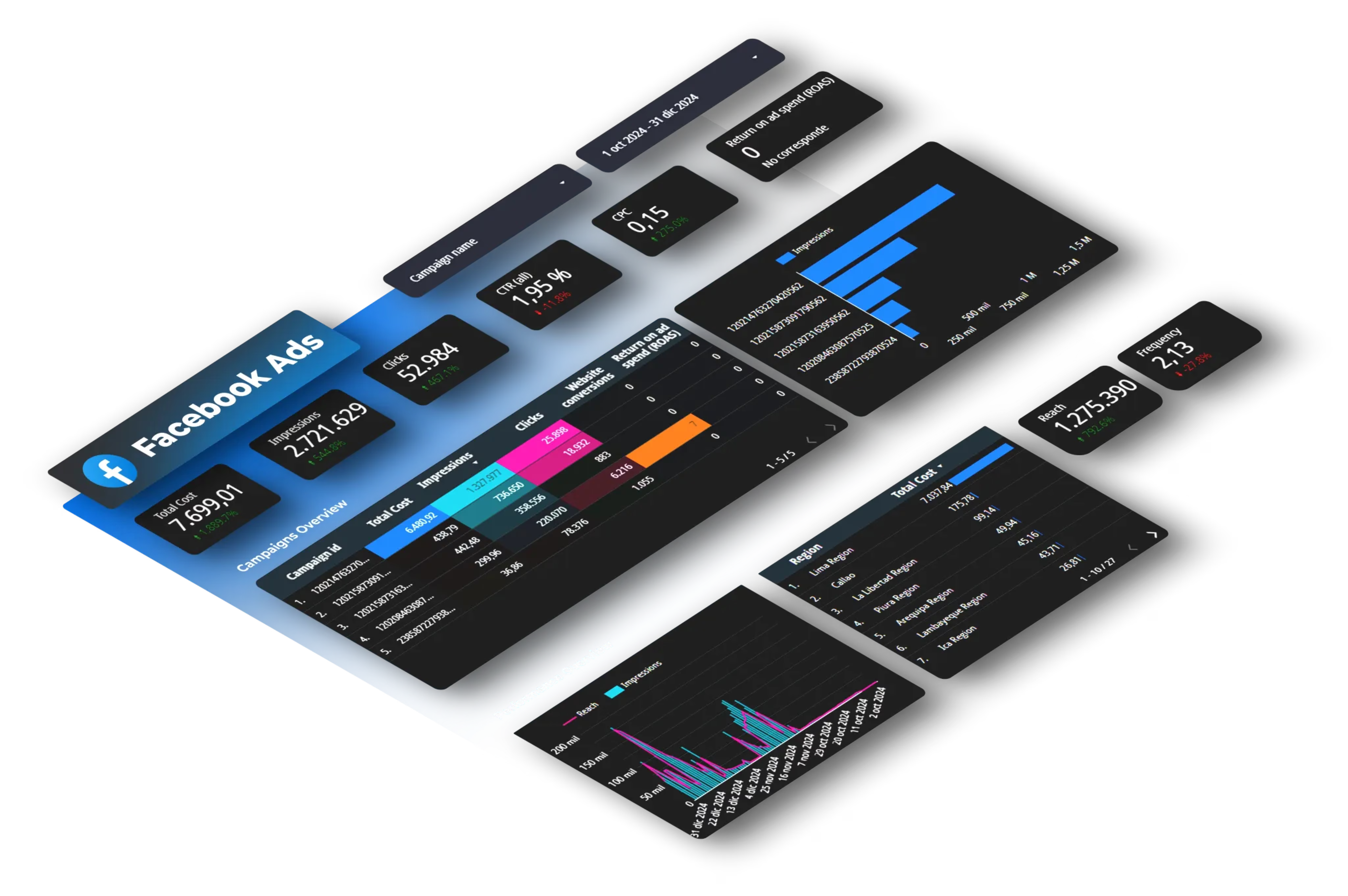
Pull Meta Ads data and Google Analytics into one location.
Manual approach: Export Ads Manager data weekly to Google Sheets. Export GA4 to the same sheet. Join on date + UTM parameters.
Automated approach: Use connectors to pull data into spreadsheets or BI tools automatically. If you're combining Meta with multiple platforms (Google Ads, LinkedIn, TikTok), automation saves hours of manual work. Tools like Dataslayer handle this for Google Sheets, Looker Studio, BigQuery, and Power BI.
Validate Weekly
You can't achieve perfect attribution. You can detect discrepancies that signal important changes.
Compare each week:
- Meta conversions vs GA4 conversions (should match within 10-15%)
- Meta spend vs credit card charges (within 1-2%)
- CPA trends without campaign changes = potential AI impact
- New vs returning customer ratio shifts
The Geographic Divide
Meta's AI targeting doesn't apply in EU, UK, or South Korea. This creates a natural experiment.
If you advertise in multiple regions, compare December 2025 vs January 2026:
- EU markets: Performance should stay relatively stable
- US/LATAM/APAC: Performance might improve if AI helps
Significant CPA improvements in non-EU markets but not EU markets = strong evidence AI conversation data is working.
What's Coming: Generative Ad Model (GEM)
Meta is developing fully automated ad creation for 2026. The vision: input your website URL and budget. Meta's AI generates creative, selects audiences, chooses placements, and optimizes bids.
This shifts competitive advantage from campaign optimization to:
- Offer quality (better products/pricing)
- Landing page experience (higher conversion rates)
- Customer retention (LTV optimization)
- Brand positioning (why choose you vs AI-recommended alternatives)
Independent attribution becomes critical because algorithmic decisions will be completely opaque.
FAQ
Can I opt out of Meta using my AI conversations for targeting?
No. Don't use Meta AI if you want to prevent data collection. Ad preferences let you reduce personalization but don't stop AI conversation data usage.
Are my past conversations used?
No. Only interactions after December 16, 2025 are included.
Can I see which conversions came from AI targeting?
No. Meta doesn't provide this breakdown. The data feeds the overall algorithm without separate reporting.
Does this apply to WhatsApp?
Only if WhatsApp is linked to Meta Accounts Center. Separate WhatsApp accounts don't share AI conversation data with other platforms.
How do I know if AI targeting is working?
Look for unexpected performance improvements (lower CPA, higher CTR) you didn't cause through campaign changes. Compare EU markets (where AI doesn't apply) vs non-EU markets.
Should I increase my Meta budget now?
Test first. Monitor December-January performance vs baseline. If you see consistent efficiency gains, gradually increase budget on improving campaigns.
What if my audience is primarily in the EU?
This won't affect you initially. If Meta expands to EU (pending regulatory approval), you might see sudden shifts. Maintain independent tracking regardless of geography.
The Path Forward
Meta AI conversation targeting makes intent data more explicit while attribution becomes more opaque.
Don't fight automation. Advantage+'s $60 billion revenue run rate proves it works. Use it.
Build independent measurement. Platform reporting will keep getting less granular. Your advantage comes from data you control.
Focus on controllable inputs. Better products, clearer offers, faster pages, stronger retention matter more when algorithms handle targeting.
Test systematically. Document what works in your data. Scale what proves effective.
The attribution black box isn't temporary. Winning advertisers will build their own transparency into an increasingly opaque system.
Next step: Export your last 90 days of Ads Manager data today. Document your baseline before AI targeting impacts more campaigns. If you need to combine Meta with other platforms like Google Ads or LinkedIn for complete attribution visibility, Dataslayer automates the data flow into your preferred reporting tool so you can focus on analysis instead of manual exports.



