



Meta's AI business assistant moved from beta to general availability for all advertisers in April 2026 (announced April 24), and as of May the rollout continues to fill in across regions. The assistant now answers account and campaign questions in plain language inside Ads Manager, Meta Business Suite, and Business Support Home, with 10 million advertiser conversations a week already running through it. The bigger announcement, signposted by Meta for the rest of 2026: campaign planning and campaign creation are coming next.
That progression matters more than the headline. Meta's AI business assistant launching as a Q&A helper is useful. The assistant gaining the ability to plan and create campaigns is a structural shift in how Meta ads run, and it puts a new burden on marketing reporting teams. If an AI is making spend decisions inside your accounts, your reporting has to be the audit trail that explains them to finance and leadership.
This post covers what the assistant does today, what it will do by year-end, and the four reporting changes marketing teams should make now to stay ahead of automated decisions they didn't personally approve.
What Meta's AI business assistant actually does
Meta's AI business assistant is built into existing Meta surfaces. No separate product, no extra cost. It works inside Ads Manager, Meta Business Suite, and Business Support Home, and supports English, Spanish, French, German, Portuguese, and Mandarin at launch.
Capabilities available now:
- Plain-language campaign Q&A. Ask "why did my CPM jump last week?" or "which audience drove the best ROAS in April?" and get an answer with the underlying numbers.
- Account issue resolution. Disabled accounts, payment failures, delivery errors, spend limit problems. The assistant walks through the most common fixes before routing to human support.
- Performance benchmarks. Compares your account's metrics against Meta's category benchmarks for businesses of similar size and vertical.
- Recommendations. Suggests creative refresh, audience expansion, bid strategy changes, or budget shifts based on account-level signals.
- Reporting summaries. Generates plain-language weekly or monthly summaries that can be shared with non-technical stakeholders without exporting to PowerPoint.
Each of those is a useful productivity gain. None of them is, by itself, a problem for marketing reporting. The shift happens with what's coming next.
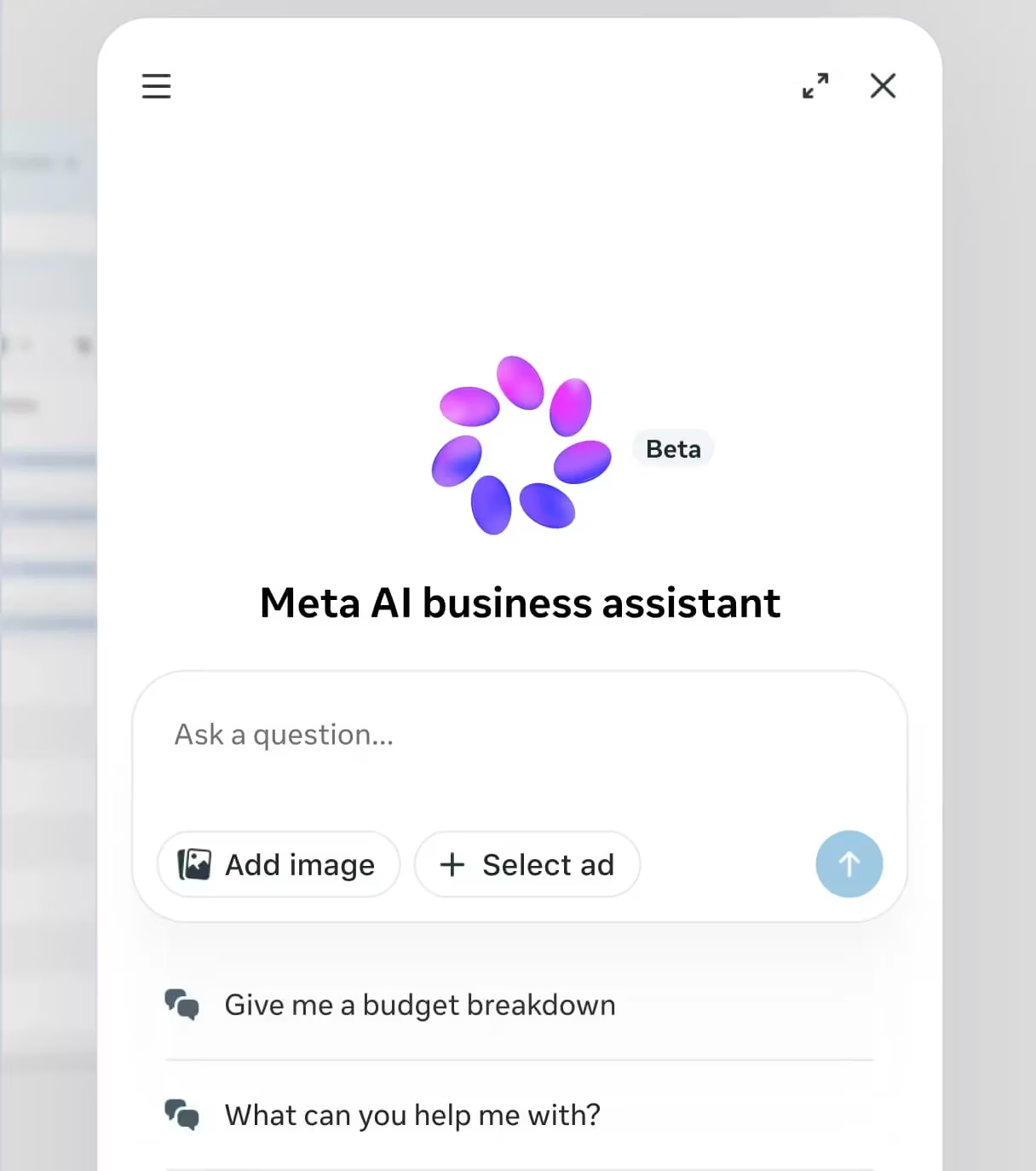
The shift from advisor to executor
Meta has been clear about the roadmap. The assistant is moving from suggesting to acting. "Throughout 2026, you can expect expanded capabilities focused on campaign planning and creation," the official rollout announcement says. The Meta Business AI Assistant page already previews campaign-planning workflows where the assistant proposes structures, drafts ad sets, and recommends initial budget allocations.
That is the shift to watch. When the assistant proposes a campaign structure, the marketer still approves. When the assistant adjusts a budget mid-flight (as Meta's Advantage+ campaigns already do), the marketer often doesn't see it until the daily check-in. By late 2026, the line between "AI suggesting" and "AI executing" inside Meta ad accounts will blur further.
For most marketing teams, this is a productivity win. For marketing reporting teams responsible for explaining results to a CMO or finance, it's a new gap to close.
The reporting gap automation creates
The core challenge: your CMO opens the monthly review and asks why your TikTok creative spend suddenly dropped 40 percent last month. If your answer is "the AI moved budget to better-performing Meta placements," that's accurate but incomplete. The CMO will ask: which placements, which audiences, what did the experiment lift look like, and was the reallocation justified by results that hold up against your account history?
Without a reporting layer that captures both Meta's account-level decisions and your team's manual interventions, those questions don't have crisp answers. Most marketing teams currently rely on Meta's native reporting for that audit trail, which works fine when the actor is human and remembered to log a note in the campaign description. It breaks when the actor is an algorithm running silently in the background.
This dynamic is part of a broader problem we covered in Why Marketing Attribution Is Broken in 2026: walled-garden AI optimization changes the inputs of measurement faster than reporting layers can keep up.
4 reporting changes marketing teams should make now
Before the assistant gains campaign-creation powers (currently expected by mid- to late 2026), build the reporting habits that will let you audit AI-driven decisions cleanly.
1. Pull Meta change history into your warehouse on a daily schedule
Meta exposes a campaign and ad set change log in Ads Manager. Most teams check it only when they're debugging a sudden performance shift. With AI-driven changes increasing, the change log becomes a primary reporting surface, not a debug tool.
The shift in practice: connect Meta Ads to your warehouse with a daily sync that includes change-log fields (budget, bid, status, audience, creative). Join those changes to performance metrics so you can answer "what changed before performance shifted?" without manual lookup. Our Meta Ads to Google Sheets guide covers the connector setup; the same data model works in any warehouse destination.
2. Tag manual vs automated interventions explicitly
If your team makes a manual budget change, log it. If Meta's Advantage+ or AI assistant makes one, the change log will record it but won't always flag the actor cleanly. Add a process: when a marketer makes a change, they leave a short note in the campaign comments field (or a separate audit log).
This is unglamorous and easy to skip. Skip it and six months from now you won't be able to reconstruct which spend decisions were yours and which were automatic. With that fog, attribution analysis loses its anchor.
3. Track AI-assistant-recommended actions as their own metric
The assistant surfaces recommendations: creative refresh, audience expansion, bid changes. Some you'll take, some you won't. Track both the recommendations and the take rate as a metric. "AI recommendations accepted" is a useful internal KPI for two reasons: it tells you how aligned the assistant is with your team's judgment, and it builds a record of decisions you skipped that turned out to matter (or not).
Most teams won't formalize this until something breaks. The teams that do it early have a clean dataset to point to when leadership asks "why didn't you take Meta's suggestion?"
4. Cross-reference Meta-level decisions against cross-platform context
The assistant sees only Meta data. When it recommends shifting budget from Reels to Stories, that recommendation is based on within-Meta performance. It doesn't know that your LinkedIn Ads campaign for the same product just hit CPL targets, that your GA4 branded search shows organic lift after the recent Reels burst, or that HubSpot deal velocity correlates with view-through campaigns the AI is about to deprioritize.
This is the structural argument for cross-source marketing reporting. For the bigger picture on consolidating data across platforms, see our Marketing Data Warehouse 2026 Guide. The point for this post: as Meta's AI gains autonomy, the value of cross-source context that the AI doesn't have grows in parallel.
Where this fits in Meta's broader automation push
The business assistant isn't an isolated launch. It sits inside a larger Meta automation strategy that already includes Advantage+ campaigns (full-funnel automation), Advantage+ creative (AI-generated ad variations), and Advantage+ audience (machine-learning audience expansion). The assistant is the conversational layer on top of those systems, plus a window into account-level diagnostics.
Together, these tools push Meta advertisers toward a workflow where the marketer sets goals, approves outputs, and audits results, rather than building campaigns from scratch. That's a useful efficiency gain at the daily level. It also means the marketer's primary value-add shifts from "I can run a Meta campaign" toward "I can verify whether the AI's decisions are working and explain them to leadership."
The reporting stack that supports the latter looks different from the one that supported the former. It needs to capture every meaningful change (manual or automated), it needs cross-source context that Meta's internal AI doesn't see, and it needs to be queryable in plain language by non-technical stakeholders. That last requirement is exactly what marketing-native data warehouses with visual query builders are built for, which we explored in Visual Query Builder vs SQL for Marketing Teams.
What's next: campaign planning and creation by year-end
Meta has signaled the next two milestones publicly:
- Campaign planning (expected mid- to late 2026). The assistant will propose campaign structures based on your stated goals, suggest budget splits across objectives, and draft initial ad set configurations.
- Campaign creation (expected by year-end). The assistant will move from proposing to creating draft campaigns ready for marketer approval, complete with audience definitions, creative variations, and placement choices.
Neither milestone has a confirmed release date yet, and Meta's track record on AI rollouts suggests staggered availability by region and ad account size. The honest read: small advertisers and agencies will see these first, with enterprise accounts gated longer for safety reasons.
For marketing reporting teams, the implication is the same regardless of timing: the velocity of changes in your Meta accounts is going up. Daily change-log sync, manual-vs-automated tagging, and cross-source context become baseline requirements rather than nice-to-haves.
FAQ
Is the Meta AI business assistant free?
Yes. It's included inside Ads Manager, Meta Business Suite, and Business Support Home at no additional cost. Meta announced general availability in April 2026 with rollout completing across regions through mid-2026.
Which languages does the AI business assistant support?
At launch the assistant supports English, Spanish, French, German, Portuguese, and Mandarin. Coverage spans the US, EMEA, APAC, and LATAM regions, with more languages expected over time.
Does the AI business assistant make changes to my account automatically?
Today, no. The assistant surfaces recommendations and answers questions but does not execute changes without marketer approval. Meta has signaled that campaign creation and budget-allocation actions are coming through 2026, which will gradually shift the assistant from advisor to executor.
How does the AI business assistant interact with Advantage+ campaigns?
Advantage+ already automates campaign structure and budget allocation within its own rule set. The business assistant runs on top, answering questions about Advantage+ performance and surfacing context-specific recommendations. The two are complementary tools inside the same Meta automation stack.
What reporting changes should I make if my team uses Meta heavily?
Pull Meta change history into your warehouse on a daily schedule, log manual interventions explicitly so they're distinguishable from AI changes, track AI-assistant recommendation acceptance rate as a KPI, and cross-reference Meta-level decisions against your full marketing stack (LinkedIn, GA4, CRM) since the assistant only sees Meta data.
Does the AI business assistant replace a media buyer?
Not in 2026. It removes the lowest-value parts of the buyer's day (account issue resolution, basic performance Q&A, benchmark lookups) and surfaces more time for strategy and creative work. The buyer's role shifts toward verifying AI decisions and providing cross-source context the AI doesn't have, rather than disappearing.
Conclusion
Meta's AI business assistant going generally available is the visible part of a deeper shift. Throughout 2026, more of the decisions inside your Meta ad accounts will be made by software rather than by your team. That's a productivity gain, until a CMO asks why spend moved and your reporting can't answer cleanly.
The four reporting habits in this post (daily change-log sync, manual-vs-automated tagging, recommendation tracking, cross-source context) are the cheapest insurance you can buy before campaign creation features land later this year. Each is a small workflow change. Combined, they're the difference between a reporting layer that explains Meta's automated decisions and one that's surprised by them.



