


Mark Zuckerberg announced in June 2025 that Meta will fully automate ad creation by late 2026. The pitch is simple: give Meta your business URL and budget, then walk away. Their AI handles everything: generates creatives, picks audiences, optimizes placement across Facebook and Instagram. Agency stocks dropped the same day. Omnicom fell 3.2%, Publicis 3.8%. Meta's stock climbed 1%. When 97% of your $160+ billion revenue comes from advertising, this isn't a side project.
What Meta's System Actually Does
According to The Wall Street Journal report, Meta's 2026 platform will generate complete ad assets from your website URL (images, videos, copy), select audiences without demographic inputs, optimize placements across Facebook, Instagram, Messenger, and WhatsApp, adjust creatives in real-time based on location and context, then allocate budget to best-performing variations automatically.
Current status: Testing with select advertisers. Public launch expected Q4 2026.
The technology already works. Meta's existing Advantage+ system shows $4.52 return per $1 spent, 22% higher than manual campaigns, according to Meta's earnings reports. The 2026 version removes the last human requirement: uploading creative assets.
That said, Meta has aggressive timelines before. Achieving true "just give us a URL" automation in 11 months requires solving edge cases around brand safety, legal compliance, and creative quality that aren't simple problems.
The Real Performance Data
These numbers come from advertiser campaigns already running AI-optimized ads. Full automation builds on proven technology, but also on campaigns where humans still uploaded assets and set parameters.
What Changes for Your Marketing Role
PPC Specialists: From Executor to Auditor
Disappearing: Manual bid adjustments, audience testing, placement optimization
Growing: AI performance auditing, cross-platform strategy, explaining black-box decisions to stakeholders
Fer Rivero, a DTC advertiser, told Bïrch: "I trust Meta's platform automation only for adding budget for active campaigns when I have my solid winners." You become the quality control, not the button-pusher.
Content Strategists: Your Work Gets More Important
The AI scrapes your website for ad content. Bad product descriptions become bad ads at scale.
Action now:
- Audit website copy (this feeds the AI)
- Structure product data clearly
- Define brand voice explicitly
- Create diverse visual assets (more inputs = better AI outputs)
Creative Teams: The 80/20 Split
Alessandro Gargiulo reported that Advantage+ "consistently found high-performing combinations and drove efficient results 80% of the time." That 80% success rate means AI handles variations (background changes, format adaptations, text overlays) while humans create strategic concepts and hero assets.
Instead of making 50 ad versions manually, you create 5 strong concepts and AI generates the variations. For more on which ad formats work best as AI inputs, see this guide to Meta ad formats.
Influencer Marketing & Social Media Managers
AI automates paid ads, making organic relationships more valuable as differentiators. Combine AI-optimized paid reach with influencer authenticity. Use automation to identify high-performing organic content, then boost it with paid spend.
The Agency Impact
WPP dropped 60% through 2025. Omnicom fell 16.4% year-to-date as of November. Not just Meta's fault, but AI automation accelerated the decline.
What's dying: Basic media buying, manual setup, generic reporting
What survives: AI strategy consulting, creative frameworks, cross-platform coordination, independent performance validation
As one Morningstar analyst noted: "The industry is being disrupted, but it's not being disintermediated." Agencies that shift from doing to directing survive.
The Problems Nobody Mentions
Black Box Optimization
You input URL + budget. Meta outputs results. Everything between is hidden. Can't diagnose failures. Can't replicate successes elsewhere. Can't learn what actually worked.
This makes independent tracking critical. When the platform won't show you why something worked, external data becomes your only verification.
Creative Sameness
When everyone uses the same AI trained on the same data, ads homogenize. The advantage goes to brands feeding unique inputs: better product photos, clearer differentiation, stronger brand voice.
Data Access Questions
Will Meta reduce transparency as automation increases? They already removed detailed targeting exclusions in January 2025, citing "22% better performance" without them. If the AI handles everything, does Meta have incentive to share granular performance data?
What To Do Right Now
Small Budget ($1,000-$5,000/month)
- Test Advantage+ on 25% of budget
- Document current performance before switching
- Give AI 2-3 weeks to learn (needs conversion data)
- Compare CPA, ROAS, creative fatigue
Medium Budget ($5,000-$50,000/month)
- Run 50/50 split: Advantage+ vs. manual
- Track externally (don't trust only Meta reporting)
- Test different creative styles to see what AI prefers
- Build email/SMS audiences outside Meta's ecosystem
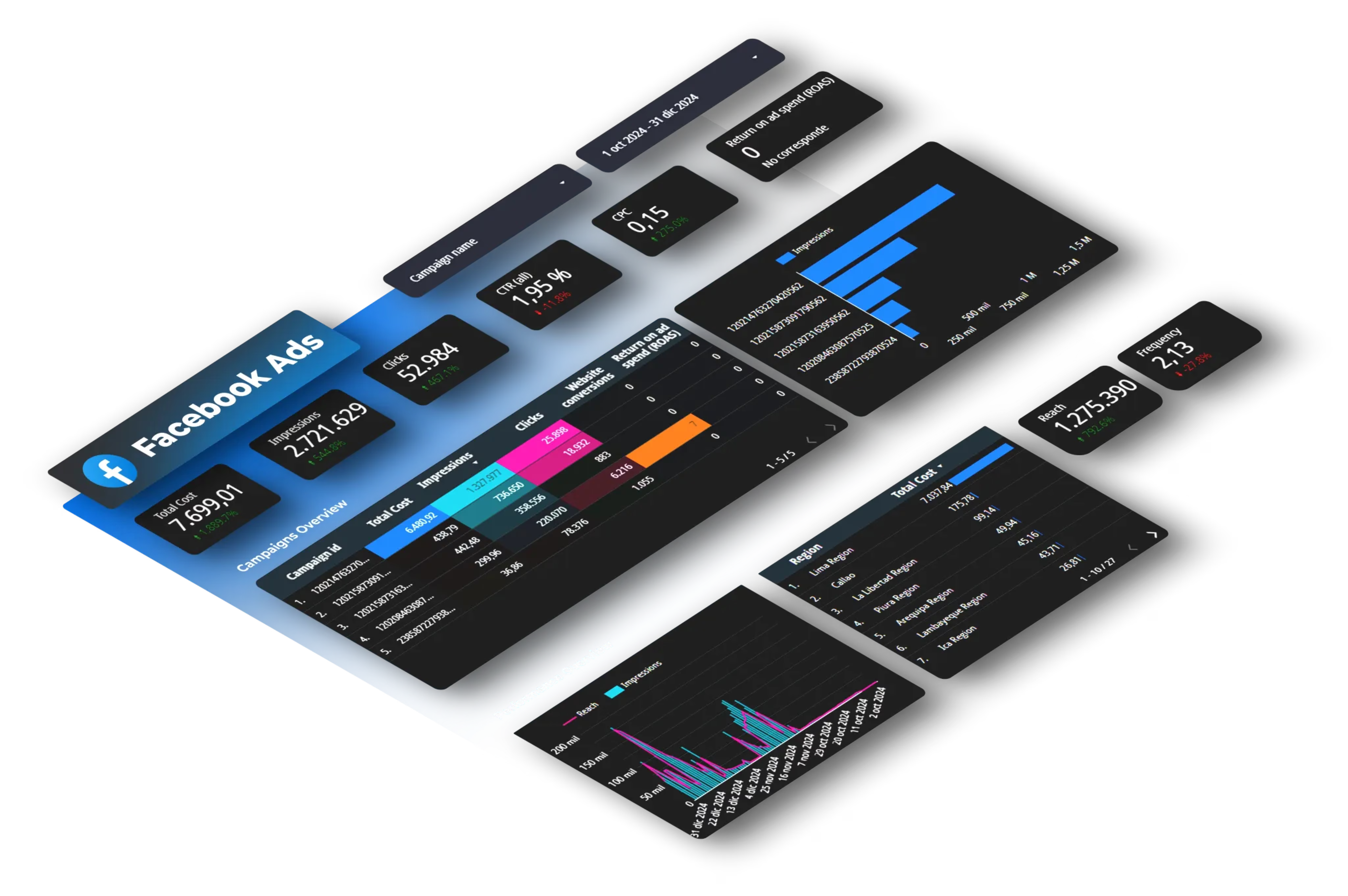
Your Meta Ads data can sync automatically to Google Sheets, Looker Studio, or BigQuery for cross-platform comparison. Check this guide on Meta dashboard setup for implementation.
Agencies & Consultants
- Audit client website quality (the AI's input source)
- Build "AI readiness assessments"
- Define when manual intervention beats automation
- Position as strategist, not executor
FAQ
Will Meta's AI kill marketing jobs?
Tactical execution jobs disappear. Strategic roles grow. Manual campaign setup becomes automated, but someone still sets objectives, interprets AI decisions, maintains brand consistency, and coordinates across platforms. The shift is from doing to directing.
How much does it cost?
Same as current Meta Ads (you set the budget). But AI needs at least 1,000 conversion events to optimize properly, which typically means $1,000-$3,000/month minimum for reliable results.
Can small businesses use this?
Yes, designed for businesses without marketing teams. The catch: your website quality matters more than ever. AI generates ads from your existing content. Weak product pages create weak ads at scale.
What happens to agencies?
They split. Agencies selling basic execution get crushed. Those offering strategy, creative frameworks, AI auditing, and cross-platform coordination stay valuable.
How do I verify the AI works?
Don't rely only on Meta's reporting. Set up tracking through Google Analytics, your CRM, or server-side tools. Compare Meta's claimed conversions against actual sales. For conversion tracking issues, see this breakdown of Meta's conversion counting.
What's the difference between Advantage+ and the 2026 plan?
Advantage+ (available now) automates targeting and budgets but requires uploaded assets. The 2026 system generates creatives from just your URL. Advantage+ already shows $4.52 per $1 spent, so 2026 builds on proven tech.
Should I stop manual campaigns now?
Run both. Allocate 25-50% to AI automation while maintaining manual campaigns. This lets you compare performance directly and gives you fallback options if AI underperforms for your specific business.
Bottom Line
Meta's full automation launches in 11 months. The AI already outperforms manual optimization in most cases. The shift from execution to strategy is happening regardless of your opinion.
What matters now:
- Creative quality (AI amplifies inputs)
- Strategic thinking (tactics automate, strategy doesn't)
- Independent validation (the black box needs external checks)
- Website content (this feeds the AI system)
Export your last 3 months of Meta performance data now. That baseline lets you measure whether AI beats your current approach when it launches.



