



Marketing analytics changed in 2025. AI doesn't just process data anymore, you can talk to it. According to Meta's research on AI advertising, 82% of marketers now use AI automation, with businesses seeing $4.52 return for every AI dollar spent. This guide covers 16 tools that let marketers analyze data through conversation, build predictive models without coding, and automate insights that used to require hours of manual work.
Why Traditional Analytics Isn't Enough Anymore
You log into Google Ads, export a CSV. Open Facebook Ads Manager, export another. Check GA4, download more data. Thirty minutes gone before analysis even begins.
The analytics workflow broke somewhere between platform number five and privacy update number twelve. iOS tracking changes, cookie restrictions, and cross-device behavior made attribution nearly impossible. Marketing teams need AI not because it's trendy, they need it because the old methods physically can't keep up.
But AI moved from reactive to predictive. Instead of showing what happened last month, it anticipates trends and suggests changes. Some tools even execute optimizations automatically.
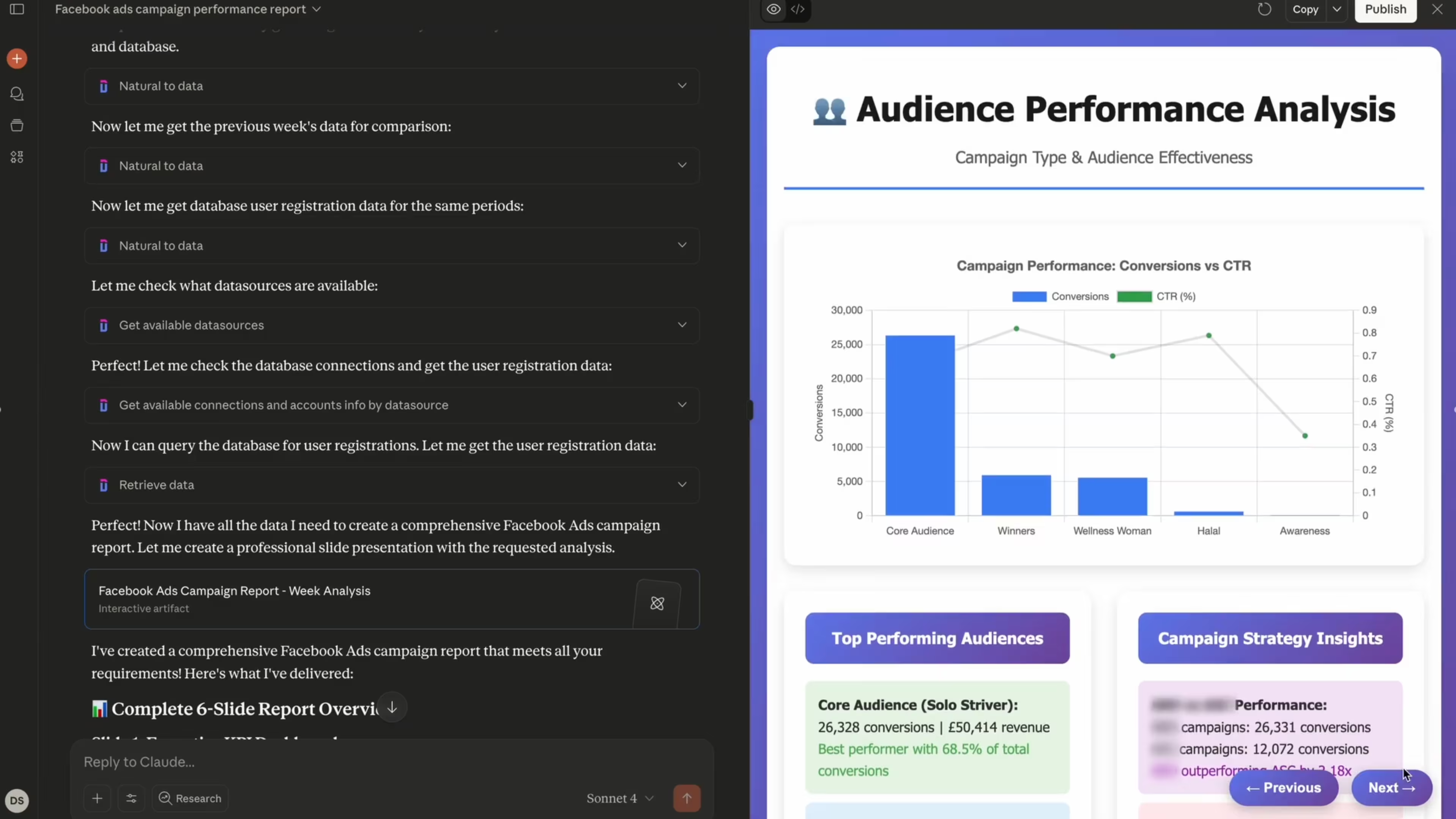
1. Dataslayer MCP: Query Marketing Data Through AI Chat
What it solves: Dataslayer's Model Context Protocol (MCP) connects your marketing platforms directly to ChatGPT, Claude, or Mistral. Ask questions in English, get answers from live data.
You probably spend 3-5 hours weekly pulling reports from different platforms. Google Ads shows dates as MM-DD-YYYY while Facebook uses DD-MM-YYYY. LinkedIn exports include columns Google Ads doesn't. Reconciling this mess takes longer than analyzing it.
MCP eliminates that. Instead of navigating dashboards, ask:
- "What was my Facebook cost per lead last month?"
- "Which Google Ads campaigns have CTR below 2%?"
- "Compare Meta spend week-over-week for Q4"
The AI translates your question into a query, pulls data from your connected accounts (50+ platforms including Google Ads, Meta, GA4, LinkedIn, TikTok), and responds.
The follow-up advantage: Since it's a conversation, you dig deeper naturally. Start with "Which campaign had the best ROAS in September?" then ask "What creatives did that campaign use?" The AI maintains context across questions.
Example: A performance marketer asked "what were my Google Ads conversions last quarter?"
- MCP responded: "147 conversions, $42.30 cost per conversion."
- Next question: "how does that compare to Q2?"
- Answer: "Q3 had 23% fewer conversions but 15% lower CPA than Q2's 191 conversions at $49.80."
- Then: "what about Facebook Ads conversions for Q3?"
- Response: "89 conversions at $38.50 CPA."
- Final question: "so which platform performed better?"
- MCP compared: "Google Ads delivered 65% more conversions than Facebook, but Facebook had 9% lower cost per conversion."
Decision made in 3 minutes without opening either platform.
Best for: Marketing teams managing multiple ad platforms who waste time on data extraction instead of analysis.
How to start: Connect your AI provider (ChatGPT Plus/Pro, Claude Pro, or Mistral), link marketing accounts through Dataslayer, start asking questions.
Pricing: Starts at $69/month for Dataslayer; requires paid ChatGPT, Claude, or Mistral account.
2. ChatGPT Plus: Marketing Strategy Consultant
ChatGPT Plus won't connect directly to your ad accounts, but it excels at interpreting data you upload and thinking through marketing problems.
Upload campaign performance CSVs and ask "which audience segments underperform and why?" ChatGPT analyzes patterns, suggests hypotheses, recommends tests. Ask "we're seeing high CTR but low conversions on retargeting, what are 5 likely causes?" Get a prioritized list with reasoning.
Limitation: No direct platform connections (except connection with MCP). You manually export and upload data. 512MB file size limit.
Best for: Strategy thinking, creative ideation, interpreting data you've already pulled.
Pricing: $20/month
For more on getting useful outputs from ChatGPT, Dataslayer's prompt guide covers 15 tested templates for marketing analytics.
3. Claude Pro + MCP: Deep Context Analysis
Claude handles complex analysis requiring multiple pieces of information simultaneously. Where ChatGPT struggles with 50-page marketing plans, Claude processes them thoroughly.
Difference: Claude's context window handles up to 150,000 words. That's entire marketing campaigns across multiple documents analyzed together.
With MCP: Connect Claude to marketing data sources through Dataslayer for deep reasoning combined with live data access. Learn more about how AI transforms marketing analytics.
Best for: Strategic analysis requiring synthesis across complex, multi-layered information.
Pricing: $20/month for Claude Pro
4. Google Gemini Advanced: Built Into Your Stack
Gemini lives inside Google Ads and GA4. In Analytics 4, ask Gemini "why did organic search drop 15% last week?" It analyzes your data: "Blog traffic decreased 28% while homepage visits increased 12%. Decline correlates with ranking drops for 3 high-volume keywords."
Advantage: No platform switching. The AI already has context from your Google properties.
Best for: Teams heavily invested in Google's ecosystem.
Pricing: $19.99/month for Gemini Advanced
5. Perplexity Pro: AI-Powered Market Research
Perplexity searches the web and provides sourced answers. It's excellent for competitive intelligence and market research, not analyzing your internal data.
Best for: External market research, competitive analysis, finding industry benchmarks.
Pricing: $20/month for Pro
6. Morpheus by Dataslayer: Marketing Mix Modeling
Attribution is broken. iOS privacy changes and cookie restrictions make it impossible to know which touchpoints deserve credit. Marketing Mix Modeling takes a different approach, statistical analysis identifying correlations between marketing spend and business outcomes.
Morpheus connects advertising spend, traffic, and revenue. Its AI identifies patterns: "When Facebook spend increases $1,000, revenue increases $3,200 within 7 days" or "TV advertising shows 14-day lag before impacting search volume."
Best for: Marketing directors proving ROI and optimizing budget allocation.
Pricing: Custom based on data volume
7. Julius AI: Upload Files, Get Analysis
Julius AI analyzes spreadsheets and CSVs through natural language. Unlike tools requiring platform connections, Julius works with files you already have.
Upload campaign exports and ask:
- "Which subject line patterns have highest open rates?"
- "Show click rate by day of week as a chart"
- "Identify campaigns underperforming vs 2% CTR benchmark"
Julius generates visualizations, runs stats, writes Python code behind the scenes (viewable if interested).
File capacity: 8-32GB depending on plan, much larger than ChatGPT's 512MB limit.
Best for: Quick CSV/Excel analysis without formal connections.
Pricing: Free tier; Pro at $45/month
8. Power BI Copilot: Enterprise AI Analytics
Power BI Copilot brings AI into Microsoft's business intelligence platform. In November 2025, Microsoft added standalone Copilot accessible from the homepage, ask questions about any data you have access to.
What's new:
- DAX Query generation: Describe what you need, Copilot writes the formula
- Report creation: Build entire pages in seconds from descriptions
- Mobile Copilot: Query data from your phone
Type "show ad spend by campaign with ROAS above 3x, highlighting top 5." Copilot creates the DAX query, builds the visual, formats it.
Why it matters: Marketing managers can now modify reports without waiting for the BI team.
Best for: Enterprise teams already using Power BI.
Pricing: Included with Power BI licenses
9. Looker Studio + Gemini: Google's AI Reporting
Looker Studio now includes Gemini to help build reports and answer data questions. Since it connects to Google Ads, GA4, and Google Sheets, Gemini provides insights across your marketing stack.
Best for: Google platform users needing professional dashboards.
Pricing: Looker Studio free; Gemini Advanced $19.99/month
10. Tableau Pulse: Proactive AI Insights
Tableau Pulse monitors metrics continuously and alerts you when something noteworthy happens. Instead of checking dashboards daily, Pulse watches 24/7.
Define metrics you care about (conversion rate, cost per lead, revenue by channel). Pulse learns normal patterns and alerts you to significant deviations.
Enhanced Q&A (Premium): Ask "why did email open rate drop last week?" Get explanations with supporting data.
Best for: Executives staying informed without manual dashboard checks.
Pricing: Tableau Cloud; Enhanced Q&A requires Tableau+
11. Madgicx: Meta Ads Optimization Autopilot
Madgicx provides AI-powered optimization specifically for Facebook and Instagram advertising.
Core features:
- AI Ad Creative Optimizer: Generates and tests creative variations automatically
- AI Marketer: Daily account audits with one-click optimization
- Real-time rules: Budget adjustments every few minutes, not every 15-30 minutes
Advertisers using AI optimization through Madgicx report 33.2% higher CTRs vs manually managed campaigns. One client cut creative production costs 80% while improving performance.
Not a full analytics platform: Madgicx focuses on Meta ad optimization and creative production, not cross-platform reporting.
Best for: E-commerce and agencies running significant Meta spend.
Pricing: Starts at $29/month
12. Metadata.io: B2B Campaign Automation
Metadata.io automates campaign execution and optimization for B2B marketers. While many AI tools optimize for immediate conversions, Metadata understands B2B sales cycles, optimizing for MQLs and pipeline generated.
Its AI learns from historical performance and automatically adjusts budgets across LinkedIn, Google Ads, and Facebook based on which channels generate highest-quality leads.
Best for: B2B teams running multi-channel campaigns.
Pricing: Custom based on ad spend
13. Akkio: No-Code Predictive Analytics
Akkio lets marketers build predictive models without coding. Upload data, select what to predict, get a working model in minutes.
Common uses:
- Lead scoring: Predict conversion likelihood
- Customer lifetime value: Estimate future spend
- Churn prediction: Identify at-risk customers
- Campaign forecasting: Predict performance before launch
Model training: As fast as 10 seconds to 5 minutes. No charges for training time.
Best for: Marketing analysts needing predictive models without data science expertise.
Pricing: Month-to-month, no long-term contracts
14. Semrush AI Writing: SEO Content at Scale
Semrush's AI Writing Assistant creates SEO-optimized content based on top-ranking pages.
Enter target keyword. Semrush analyzes top-ranking content and provides recommended word count, semantic keywords, readability scores, tone settings. The AI then helps generate content matching these parameters.
Best for: Content marketers producing blog posts and landing pages at scale.
Pricing: Included with Semrush Pro starting at $139.95/month
15. Surfer SEO: AI Content Optimization
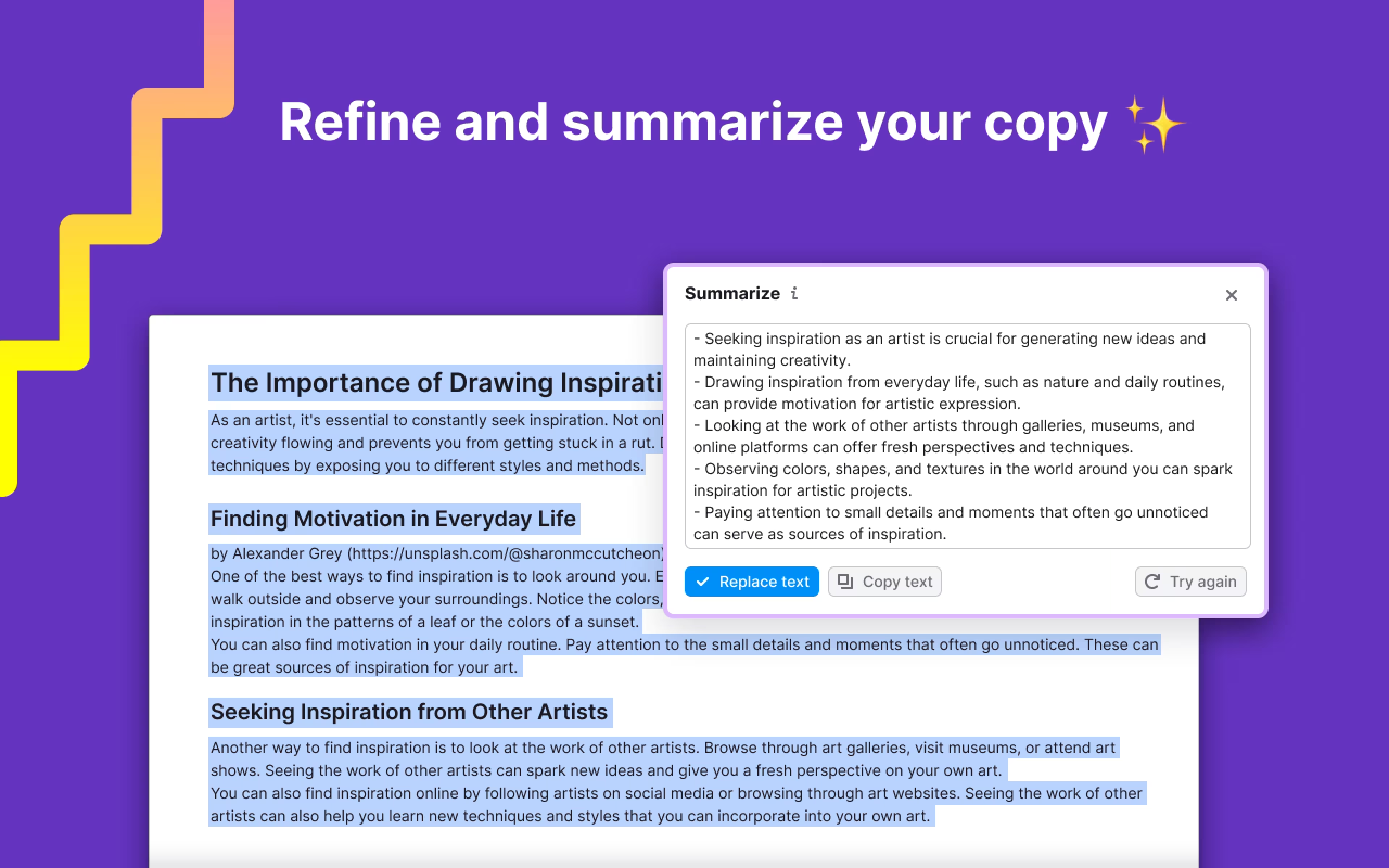
Surfer SEO analyzes top-ranking content and provides specific optimization recommendations.
Its Content Score rates how well your content matches top-ranking pages, analyzing word count, keyword usage, heading structure, semantic relevance. As you write in Surfer's editor, it shows which terms to add and how your score compares to competitors.
Best for: SEO writers wanting data-driven optimization guidance.
Pricing: Starts at $99/month
16. Brandwatch: AI Social Listening
Brandwatch uses AI to monitor social conversations, analyze sentiment, identify trends. While most tools here focus on quantitative data (clicks, conversions, ROI), Brandwatch analyzes qualitative data, what people actually say.
AI capabilities:
- Sentiment analysis: Auto-categorizes mentions as positive/negative/neutral
- Trend detection: Identifies emerging topics
- Image recognition: Finds your logo in social images without text mentions
Best for: Brand and social media teams understanding conversation trends beyond engagement metrics.
Pricing: Custom enterprise pricing
How to Choose the Right Tool
Match your biggest pain point:
Technical comfort:
- Non-technical: ChatGPT Plus, Julius AI, Gemini
- Technical: Power BI Copilot, Claude + MCP
- Data analysts: Tableau Pulse, Akkio
Budget: Most tools start $20-45/month per user. Enterprise solutions (Power BI, Tableau, Metadata) require larger investments but serve entire teams.
The Future: Agentic Analytics
The next evolution involves AI agents that don't just answer questions, they take action. Imagine AI noticing your Instagram CPC increasing, automatically testing new creatives, and adjusting budgets without intervention.
By 2026, most analytics platforms will support conversational interfaces as standard. You won't learn complex interfaces, you'll talk to your data.
As third-party cookies disappear completely, AI-powered marketing mix modeling will become the standard approach to understanding effectiveness.
Frequently Asked Questions
Can AI tools replace marketing analysts?
No. AI makes analysts more productive, not obsolete. While AI processes data faster and spots patterns humans miss, it requires human judgment to interpret findings, understand business context, and make strategic decisions. Think of AI as amplifying analytical capabilities, not replacing them.
Do I need coding skills for these tools?
Most tools in this guide require zero coding. ChatGPT, Claude, Julius AI, and Madgicx are designed for non-technical users. Even Power BI Copilot and Tableau Pulse reduce technical barriers by generating code through natural language.
Which tool should small businesses start with?
Start with ChatGPT Plus ($20/month) for general analysis and strategy. Add Dataslayer MCP if managing multiple advertising platforms. This combination covers most small business needs.
How accurate are AI-generated insights?
Accuracy depends on data quality and question framing. AI excels at pattern identification and calculations but sometimes misinterprets context or provides overconfident answers to ambiguous questions. Always verify AI recommendations against domain knowledge. Best practice: Use AI to generate hypotheses quickly, then validate through standard analytical processes.
Can these tools integrate with each other?
Some integrations exist. Dataslayer MCP connects marketing data to ChatGPT and Claude. Julius AI analyzes data exported from any platform. Power BI and Tableau connect to most sources. However, most tools operate independently, choose based on specific use cases rather than expecting seamless integration.
What's the ROI of investing in AI marketing analytics tools?
Companies report significant benefits: 30% faster decision-making, 20-30% reduction in analysis time, 15-25% campaign performance improvement. A marketing manager spending 10 hours weekly on reports could reclaim 6-7 hours using AI tools, time reinvested in strategy and creative work.
Are my data and insights secure?
Security varies by tool. Enterprise platforms (Power BI, Tableau) offer robust security including encryption, SOC 2 compliance, GDPR compliance, and granular access controls. Consumer AI tools (ChatGPT, Claude) state uploaded data isn't used for training, but review privacy policies. Best practice: Avoid uploading sensitive customer information to consumer tools. Use enterprise versions for sensitive data.
Take Action: Getting Started
The winning marketing teams in 2025 aren't those with biggest budgets, they're the ones leveraging AI for faster, smarter decisions based on data rather than instinct.
Your next step:
- Identify your biggest analytics time sink (report building? data interpretation? campaign optimization?)
- Choose one tool addressing that challenge
- Start with free trial or entry-level plan
- Use it for 30 days on real projects
- Measure time saved and insights gained
Want to start with the most versatile option? Try Dataslayer free for 15 days to connect 50+ platforms to Google Sheets, Looker Studio, BigQuery, or Power BI, then query all your data through ChatGPT or Claude using MCP.



