


LinkedIn launched Reserved Ads in June 2025, a way to lock in the first ad slot in the LinkedIn feed for your entire campaign, not just win it through auction bidding. Think of it as buying a billboard on a specific highway instead of hoping your ad wins placement each day. The announcement came with First Impression Ads (24-hour video takeovers) and three AI tools that automatically personalize ad copy, generate headline variations, and test creative combinations. The timing makes sense: LinkedIn's research shows 91% of B2B marketers say grabbing attention is their biggest challenge, and 77% believe day one of a campaign drives the highest impact.
What LinkedIn Reserved Ads Actually Do
Reserved Ads let you book the first Sponsored Content position in the feed for multiple days or weeks. You're not bidding against other advertisers, you're paying upfront to guarantee placement.
You can run this with Thought Leader Ads (executive posts), Single Image Ads, Document Ads, or Carousel Ads. What you can't do is use custom retargeting audiences. LinkedIn sells these with predefined segments like "tech decision-makers at companies with $100M+ revenue" or "marketing leaders at SMBs."
According to AJ Wilcox from B2Linked, who covers LinkedIn ads updates closely, this is slated for broader rollout through Q4 2025. Right now it's managed accounts only, you need to contact LinkedIn's sales team, not use Campaign Manager.
Pricing isn't public yet, but based on First Impression Ads requiring $60,000 minimum, expect $15,000-$50,000 per campaign depending on how long you run it and who you're targeting.
Reserved Ads vs First Impression Ads vs Regular Auction
First Impression Ads are vertical video only, last 24 hours, and guarantee you're the first ad someone sees that day. Reserved Ads run longer (days or weeks) and support more formats. Regular auction ads cost less but compete for placement every time, if 20 other advertisers are bidding on "CFOs at SaaS companies," you might pay $12 per click and still not show up first.
Why LinkedIn Built This (And Who Actually Needs It)
LinkedIn's 2025 research surveyed 3,000+ B2B marketers across 13 countries. They found 90% of Indian marketers and 94% of Singapore marketers cite attention as their top challenge. Meanwhile, 68% of CMOs globally say leadership is risk-averse and prefers guaranteed outcomes.
That's the problem Reserved Ads solve. Instead of spending $30,000 on auction ads and hoping you win enough impressions, you pay a fixed premium and know exactly what you're getting.
When this makes sense:
You're launching enterprise software at a conference and need every target CMO to see your announcement that week. You're in a crowded auction where CPCs hit $10-15 and you're tired of bidding wars. You have a fixed-date event and can't risk low delivery.
When to skip it:
Your budget is under $10,000 monthly. You're still testing audiences and messages. You care more about cost per lead than guaranteed impressions. You need custom retargeting (website visitors, uploaded lists).
Most advertisers will keep using standard auction ads for lead generation and only use Reserved Ads for 1-2 major campaigns per year where timing and visibility matter more than direct ROI.
The 3 AI Features That Launched Alongside
AI-Powered Ad Personalization
LinkedIn now auto-inserts profile data into your ad copy. Write a headline like "Hi {firstName}, see how {jobTitle}s cut reporting time by 60%" and the system fills it in: "Hi Sarah, see how Marketing Directors cut reporting time by 60%."
You can add first name, job title, industry, or company name. Social Media Today reports this rolled out in December 2025 for all Sponsored Content campaigns.
The catch: about 15-20% of profiles are private or missing data, so those users see your fallback version. Always write solid copy that works without personalization.
AI Ad Variants
Click "Draft with AI" in Campaign Manager and LinkedIn generates 3-5 headline alternatives from your original. If you write "Our CRM cuts sales cycles by 30%," you might get:
- "Sales teams close deals 30% faster"
- "Cut your sales cycle by a third, 1,200+ teams did"
- "30% shorter cycles: Real CRM results"
You review, edit if needed, and pick 2-3 to test. Early data suggests this lifts CTR by 20-37% versus single static ads, though results vary by audience.
Flexible Ad Creation
Upload up to 4 images, 4 videos, and 4 copy variations. LinkedIn's system tests combinations (up to 64 possible variations) and automatically shifts budget to winners. Similar to Meta's Advantage+ Creative but for B2B audiences.
Currently in preview for select accounts, wider rollout expected early 2026.
What LinkedIn Ads Actually Cost in 2025
Standard auction campaigns average $2-10 per click, with most B2B advertisers seeing $5-7. WebFX's 2025 data shows tech and SaaS companies pay $7-10 CPC, financial services $6-8, healthcare $5-7.
CPM (cost per 1,000 impressions) runs $5-8. Minimum daily budget is $10, though you need $50+ daily for AI optimization to work properly.
Reserved Ads will cost significantly more, likely $80-120 CPM based on industry estimates, because you're buying guaranteed premium placement. If standard auction gets you 200,000 impressions for $10,000, Reserved Ads might deliver 1.5-2 million impressions for the same budget but with first-slot guarantee.
How to Set Up AI Personalization (Available Now)
Open Campaign Manager, create a new Sponsored Content campaign, and toggle "Use ad personalization" under the ad format section.
Write your copy with placeholders: {firstName}, {jobTitle}, {industry}, {company}. Preview it to make sure the fallback version (what shows when data is missing) still reads well.
For AI variants, click "Draft with AI" after writing your first headline. Review the options, they're not always perfect. AI sometimes produces generic phrases like "best-in-class solution" because that appears frequently in training data. Edit before approving.
Budget recommendation: $50 daily minimum. Lower budgets don't give the algorithm enough data to optimize properly. If you're testing 3 headline variants with $20 daily budget, each variant only gets 30-40 clicks before your budget runs out, not enough to determine a winner.
For Reserved Ads, you'll need to contact LinkedIn's managed services team. They handle audience building and inventory reservation. Minimum campaign budgets start around $15,000.
Tracking Performance Beyond Direct Clicks
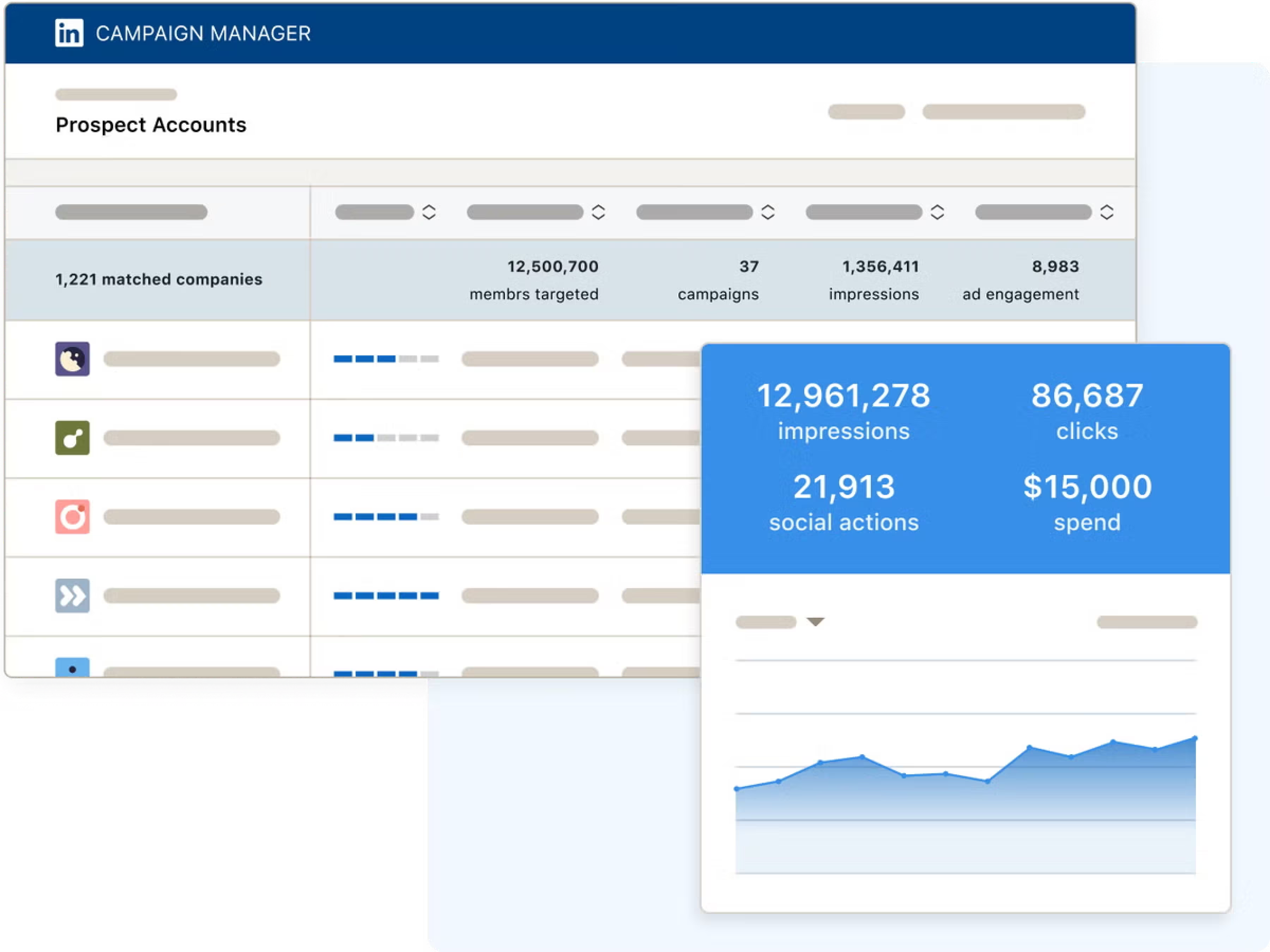
The biggest challenge with Reserved Ads is measuring impact when someone sees your ad but doesn't click immediately. They might search your brand name three days later, visit your site, and convert. Google Analytics shows "Organic Search" as the source, but the Reserved Ad drove that behavior.
Three ways to track this:
- Install LinkedIn's Insight Tag and connect your CRM (HubSpot, Salesforce, Marketo). Revenue Attribution Reporting shows how early-stage impressions contribute to later conversions. You'll see patterns like: Saw Reserved Ad June 1 → Organic search June 15 → Demo request June 20 → Closed deal July 10.
- Track branded search volume in Google Search Console during your campaign. Compare it to the previous 4 weeks. One B2B company saw branded searches jump 47% during their Reserved Ads week. Of those 3,200 extra searches, 380 converted to demos, even though the direct Reserved Ads clicks only generated 89 conversions.
For campaigns over $60,000, LinkedIn offers brand lift studies. They survey people who saw your ad versus a control group and measure differences in brand recall, purchase intent, and message association. - If you're running campaigns across LinkedIn, Google Ads, and Facebook simultaneously, consolidating metrics helps you see the full picture. Tools like Dataslayer can pull data from all platforms into one dashboard so you can compare Reserved Ads awareness metrics against direct response performance elsewhere.
Common Problems
"My personalized ads show {firstName} instead of actual names"
About 15-20% of users have private profiles or incomplete data. Your fallback version appears for them. Test with a small audience (1,000 people) first to check error rates before scaling. Never rely 100% on personalization, the fallback needs to be strong standalone copy.
"Reserved Ads cost more per lead than auction ads"
That's expected. Reserved Ads are awareness campaigns, you're paying for impressions and brand recall, not immediate conversions. Typical Reserved Ads CPL is $200-500. Standard Lead Gen campaigns run $50-150 CPL. Use Reserved Ads for top-of-funnel awareness, then retarget those viewers with cheaper direct response ads. The combination usually performs better than either alone.
"AI-generated variants all sound the same"
Common issue. AI might start all 5 variants with "Discover how..." or produce repetitive corporate language. Provide stronger base copy with specific numbers and unique phrasing. AI matches your input quality. If your original is punchy and specific, variants improve. If your original is vague, variants get worse.
"I can't get Reserved Ads inventory for my launch date"
Only one advertiser can run First Impression Ads per market per day, and Reserved Ads have similar capacity limits. Book 6-8 weeks ahead for major campaigns. Consider targeting smaller segments, "California tech CMOs" has more availability than "All US CMOs."
FAQ
What's the difference between Reserved Ads and regular Sponsored Content?
Regular Sponsored Content uses auction bidding. You set a max CPC bid (say $8), compete with other advertisers, and pay based on clicks or impressions. Your ad might show up third or fifth in someone's feed depending on auction results. Reserved Ads use fixed pricing to guarantee first-slot placement throughout your campaign. You're not bidding, you're buying specific inventory upfront. It costs significantly more (estimated $15,000-$50,000 per campaign versus $10 daily minimums for auction) but eliminates placement uncertainty. Best for time-sensitive launches where you need guaranteed visibility.
Can small businesses afford Reserved Ads?
Not really. Reserved Ads require managed service accounts, typically for advertisers spending $50,000+ annually on LinkedIn. The minimum campaign budget appears to be $15,000-$50,000 based on First Impression Ads pricing. Small businesses should use the AI features instead, personalization, variants, and Accelerate all work with standard auction ads starting at $10 daily. Focus on profitable lead generation first. Once you're consistently converting at $50-100 CPL and have budget to scale, then consider Reserved Ads for 1-2 major launches yearly.
Does AI personalization work better than A/B testing?
They serve different purposes. A/B testing compares two complete ad versions to find which offer, value prop, or creative works better. AI personalization dynamically customizes a single template for each viewer, "Hi Sarah" for one person, "Hi Michael" for another. Use both: A/B test to find your winning message ("Free trial" beats "Book demo"), then add AI personalization to that winner for extra lift. A/B testing might improve CTR 20-30%. Personalization on top adds another 15-25%. Limitation: 15-20% of users have private profiles so they see generic fallback versions.
How much should I budget to test AI ad variants properly?
You need $3,000-$5,000 minimum campaign budget to get statistically significant results. Testing 4 headlines with only $500 budget means 50-100 clicks per variant, not enough data to determine a real winner versus random noise. With $5,000 budget at typical $5 CPC, you get 1,000 clicks to distribute across variants. That's 250+ clicks per variant if testing 4, enough to see patterns. Below $3,000, skip variants and write one strong headline instead. Run tests for 2-3 weeks minimum. Don't pause underperforming variants after 3 days, the algorithm needs time.
Can I retarget website visitors with Reserved Ads?
No. Reserved Ads only support LinkedIn's predefined professional segments like "Marketing leaders at SMBs" or "Tech decision-makers at $100M+ companies." You cannot upload custom lists (website visitors, email contacts, company names). Standard auction ads do support Matched Audiences for retargeting via Insight Tag, uploaded lists, or video viewers. The workaround: Use Reserved Ads to reach cold audiences, install Insight Tag to track who visits your site from those ads, then create a Matched Audience and retarget them with cheaper Lead Gen ads. Typical funnel: 1M Reserved impressions → 15K site visits → 2K retargeting pool → 200 leads from retargeting.
How do I track Reserved Ads if users don't convert immediately?
Install LinkedIn's Insight Tag and connect your CRM to use Revenue Attribution Reporting. This shows how impressions contribute to conversions days or weeks later. Also track branded search volume in Google Search Console, measure weekly searches for your brand name during the campaign versus the previous month. Many conversions that appear as "Organic Search" in Google Analytics were actually triggered by Reserved Ads awareness. For campaigns over $60,000, request LinkedIn's brand lift study. They survey exposed users versus control groups to measure recall and intent differences. Use UTM parameters with unique weekly codes to track bookmarked visitors who return via direct traffic.
Will AI variants accidentally use competitor names?
No. LinkedIn's AI filters competitor brand names, trademarks, and policy violations. But AI-generated copy isn't perfect, expect generic corporate phrases ("industry-leading platform"), tone mismatches with your brand voice, or number changes ("1,200+ customers" becomes "thousands of customers"). Always review variants before publishing. Spend 5 minutes editing versus 30 minutes writing from scratch. LinkedIn blocks prohibited content, checks trademarks, and reviews for discriminatory language. Treat AI like a junior copywriter's first draft, helpful starting point but needs polish. The 80/20 rule: AI does 80% of work, you refine the final 20%.
Should You Actually Use Reserved Ads?
Most B2B marketers won't need Reserved Ads regularly. The $15,000-$50,000 minimum makes sense only when:
- You have a major product launch with a fixed date and guaranteed visibility matters more than immediate ROI.
- You're competing in saturated audiences where auction CPCs exceed $8-10 and you're tired of bidding wars.
- You're already profitable with standard ads ($50-150 CPL) and want to add top-of-funnel awareness.
- You can measure full-funnel attribution beyond direct clicks.
If you don't meet at least two of those criteria, start with AI-powered auction ads instead. Personalization, variants, and Accelerate deliver most optimization benefits without premium pricing.
Practical approach: Run AI-optimized auction ads for 6 months. Prove consistent lead generation. Build retargeting audiences. Then use Reserved Ads for your biggest annual launch, using awareness to fill the funnel while retargeting continues driving conversions at lower cost.
The AI features are available to everyone now and genuinely useful. Reserved Ads are a specialized tool for specific high-stakes campaigns, not something you'd run continuously.



