



Mark Zuckerberg outlined Meta's endgame for advertising in May 2025: "You're a business, you come to us, you tell us what your objective is, you connect to your bank account, you don't need any creative, you don't need any targeting demographic, you don't need any measurement."
Upload an image. Set your budget. Let AI generate the ads, find the audience, and optimize delivery.
This isn't speculation. Meta has already deployed the infrastructure. The company's Lattice, Andromeda, and GEM systems are running right now, driving measurable performance improvements. The goal-only interface is the final piece, expected by late 2026.
For marketers, this means rethinking what skills matter and how to maintain competitive advantage when everyone uses the same AI tools.
The Three AI Systems Already Running
Meta Lattice: Behavioral Prediction
Lattice is Meta's machine learning architecture. According to research published in December 2025, deployed Lattice at Meta delivered 10% improvement in revenue-driving metrics, 11.5% uplift in user satisfaction, and 6% boost in conversion rate.
The system enables cross-objective learning. Insights from e-commerce campaigns improve B2B lead generation, and vice versa. It also powers sequential ad delivery, showing ski equipment ads after someone books a ski resort rather than more ski resort options.
Meta Andromeda: Ad Retrieval at Scale
Andromeda handles the first stage of ad delivery: narrowing millions of potential ads to a few thousand candidates. Built on NVIDIA Grace Hopper Superchips, it delivered +6% recall improvement and +8% ads quality improvement in Meta's testing.
The system processes hundreds of times more ads than previous infrastructure, necessary because Advantage+ Creative generates hundreds of variations from a single ad. We covered how Andromeda changed Meta's campaign philosophy when it rolled out in 2024.
Meta GEM: Cross-Platform Learning
GEM (Generative Ads Model) launched in Q2 2025 and learns from both paid ads and organic content across Meta's platforms. Before GEM, Instagram optimization didn't communicate with Facebook optimization.
Meta reported GEM increased conversions by 5% on Instagram and 3% on Facebook Feed automatically, with no campaign restructuring required. According to Meta's engineering blog, GEM is 4X more efficient at driving performance gains compared to their original ranking models.
Current Performance: The Data
Advantage+ campaigns already deliver:
- 22% higher ROAS than manually managed campaigns
- $4.52 return per $1 spent on average
- 10% lower cost per qualified lead
Over 1 million advertisers used Meta's generative AI tools to create 15+ million ads in a single month. Advertisers using image generation tools reported 7% higher conversions.
The EU Exception: How Regulations Changed Everything
The €200 Million Fine
In April 2025, the European Commission fined Meta €200 million for breaching the Digital Markets Act. Meta's "consent or pay" model, users either consent to full tracking or pay for ad-free service, didn't comply with DMA requirements.
The DMA mandates gatekeepers offer a "less personalized but equivalent alternative" service. Meta's binary choice failed this test.
Three-Tier Model (January 2026)
Meta now offers EU users three options:
- Fully personalized ads, share all data, free access
- Less personalized ads, limited data sharing based on contextual signals, free access
- Ad-free subscription, paid, no data collection
The European Commission approved this model in December 2025, with rollout beginning January 2026.
In its Q2 2025 investor report, Meta stated the changes "could result in a significant impact to our European business and revenue." Less personalized ads may deliver 20-40% lower performance, creating two distinct advertising systems globally.
New Ads Manager Features
Meta deployed several updates supporting the automation transition:
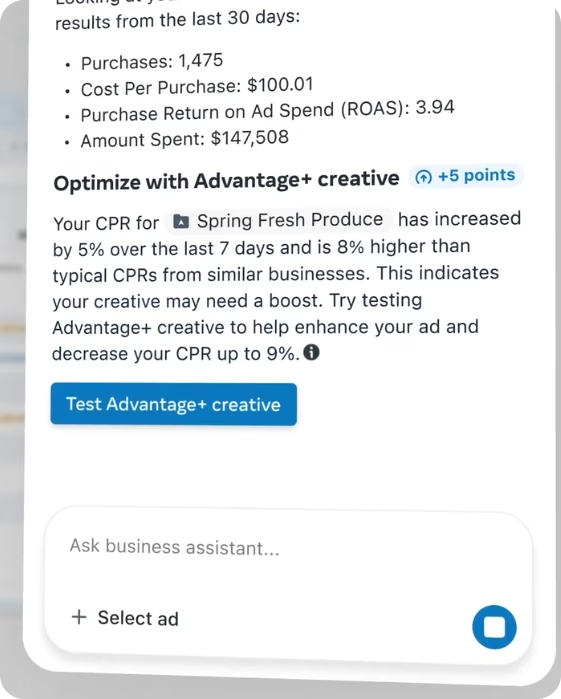
- Business AI Breakdown: Shows which conversions came from AI optimizations versus standard delivery.
- Attribution Settings View: Analyze results by attribution window (1-day click, 7-day click, 1-day view) in one interface.
- Promotions Before Click: Display offers with "See offer" CTA directly in ad creative.
- Advantage+ as Default: New campaigns default to automated settings. Manual control requires opting out.
What Changes for Marketers
Skills Losing Value
Manual targeting expertise becomes less relevant when AI discovers audiences automatically. Same for placement optimization, bid management, and traditional A/B testing with 2-4 variants.
The exception: Value Rules introduced in June 2025 give advertisers some bid control back, but typically increase costs 20-1000%.
Skills Gaining Value
Creative strategy: AI generates variations but can't define your brand positioning or messaging strategy.
Website quality: When AI scrapes your site for ad content, your product descriptions become your ads. Poor content in, poor ads out.
Data infrastructure: AI optimization requires accurate conversion signals. Implementing Conversions API correctly and maintaining clean event data becomes critical.
Strategic objectives: Telling AI to "maximize purchases" versus "maximize customer lifetime value" produces different results. This requires human judgment.
Cross-channel strategy: When Meta's AI handles execution, focus shifts to budget allocation across platforms and identifying diminishing returns.
The Commoditization Problem
When every advertiser uses the same AI trained on the same data, winning tactics spread fast.
What gets commoditized:
- Ad formats that work
- Headline formulas
- Sales hooks and messaging angles
What remains defensible:
- Authentic brand assets (real customer testimonials, genuine content)
- Product quality and post-click experience
- Strategic positioning
- Multi-channel coordination
Preparation Checklist
Immediate (Next 30 Days)
- Implement Conversions API if not deployed
- Verify Meta Pixel fires correctly on all key pages
- Check event match quality scores (target: 70%+)
- Allocate 25% of budget to Advantage+ campaigns
- Run 2-3 week comparison: Advantage+ vs. manual
Medium-Term (Next 90 Days)
- Review and improve product descriptions on your website
- Upgrade product photography
- Add or refresh customer testimonials
- Document brand voice and prohibited phrases
- Build system for producing 10-15 creative concepts weekly
Long-Term (6-12 Months)
- Set up external tracking (Google Analytics 4, marketing mix modeling)
- Train team on creative strategy and data infrastructure
- Diversify channel strategy beyond Meta
- Build owned channels (email, SMS)
The Agency Impact
Following Zuckerberg's May 2025 announcement, stock prices for major advertising holding companies fell 2-3%.
Services being automated: campaign setup, audience research, creative testing, bid management, basic reporting.
Agencies that adapt shift from execution to brand strategy, multi-channel orchestration, advanced attribution, and change management. In-house roles evolve similarly, from campaign managers to creative strategists, data architects, and AI performance auditors.
Timeline
2024: Andromeda and GEM deployed
2025: Zuckerberg outlines vision (May), EU fine and model revision (April-December), 83+ platform changes
2026: EU three-tier model launches (January), goal-only beta (Q1-Q2), general availability target (Q3-Q4)
FAQ
Will manual campaign management still exist?
Yes, but it's becoming the exception. Advantage+ is now default, you must actively opt out.
How can small businesses compete when everyone has the same AI?
Focus on what AI can't replicate: authentic brand voice, unique positioning, superior customer experience, genuine content.
Should I wait until goal-only launches?
No. The transition is already happening through Advantage+. Test now.
How do I validate AI performance claims?
Use Meta's Business AI Breakdown and maintain external tracking through Google Analytics or marketing mix modeling.
Will this make advertising more expensive?
Unclear. Efficiency could lower costs per conversion, but increased competition from new advertisers could raise CPMs. Early Advantage+ data shows cost reductions.
Conclusion
Meta's goal-only vision is the endpoint of systems already delivering measurable improvements. The infrastructure exists. The performance data validates the approach.
For marketers, the shift is from controlling campaigns to mastering inputs. AI handles execution, creative distribution, audience discovery, bid optimization. You own the brand, product quality, and strategic direction. Tactical execution becomes automated and strategic thinking becomes essential.



