


%20Creator%20Reach.avif)
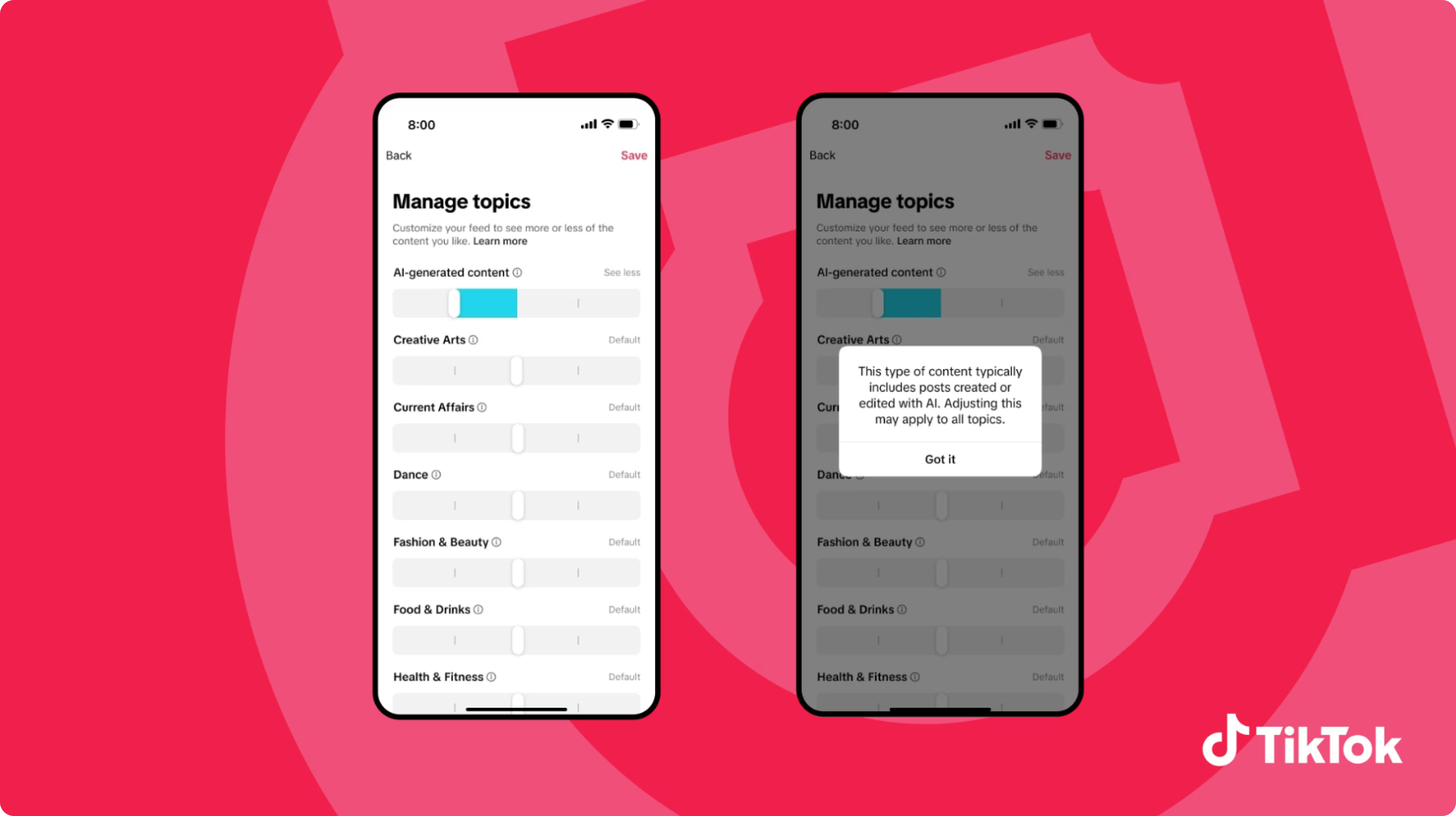
TikTok rolled out an AI content filter in November 2025. Users adjust how much AI-generated content shows up in their For You feed through a slider in Settings > Content Preferences. According to a 2024 Bynder study, 52% of consumers disengage when they suspect content is AI-generated, even if they can't prove it. For creators and marketers, this means AI-heavy videos could see reduced reach as users dial down synthetic content. TikTok identifies AI through C2PA Content Credentials and invisible watermarking that survives re-uploads and basic editing.
The New Toggle and What It Actually Does
Go to Settings > Content Preferences > Manage Topics. There's now a slider for AI-generated content (AIGC) sitting next to Dance, Sports, Food & Drinks, and 10 other topic controls.
You can move it toward "see less" or "see more." You cannot turn off AI content completely, TikTok explicitly says this is about "tailoring the diverse range of content" rather than eliminating categories.
The timing matters. Meta launched Vibes (an AI-only video feed) in September 2025. Around the same time, OpenAI's Sora gained traction. Realistic AI-generated videos flooded TikTok: historical recreations, celebrity deepfakes, synthetic environments that look like real footage. User complaints about "AI slop" hit a peak. TikTok responded.
Impact for Marketers: The Reach Problem
The Perception vs. Reality Gap
71% of social media images are now AI-generated. That's a lot of synthetic content competing for attention. When users adjust their slider to "see less," the algorithm learns. Videos flagged as AI-generated get lower distribution, especially to users who've opted out.
But a 2024 Bynder study showed 56% of participants preferred AI-generated articles when they didn't know the source. Once they suspected AI involvement, 52% reported reduced engagement. It's not about quality. It's about trust.
For paid campaigns, this is brutal. TikTok ads average:
- 0.84% click-through rate
- 0.46% conversion rate
- 4.07% engagement rate (still way higher than Facebook's 0.09% or Instagram's 1.22%)
If your creative leans heavily on AI-generated visuals or voices, and users increasingly opt out, you're paying to reach people who've told the algorithm they don't want to see your content type.
What TikTok Labels as "AI Content"
Gets labeled: Fully AI-generated videos (Sora, Runway), realistic synthetic people/places/events, AI voice clones, deepfakes
Doesn't get labeled: AI-assisted editing, scripts written with ChatGPT but performed by humans, AI music selection, thumbnail enhancements
You can use ChatGPT to write every word. If you're on camera delivering it, that's human content.
How TikTok Detects AI
TikTok uses two methods:
- C2PA Content Credentials: Industry standard that embeds metadata (creation timestamp, tools used, edit history) into files. When you upload from Adobe Firefly or Midjourney, TikTok auto-applies the label. Problem: labels get stripped when content is edited or re-uploaded.
- Invisible Watermarking: Signals embedded in pixels and audio that only TikTok can read. Survives re-uploads, basic edits, and compression. Gets added to TikTok AI tools content, C2PA uploads, and detected AI content. 1.3 billion videos labeled to date.
Strategy: When AI Works
Where AI still wins: Research/planning, script refinement (human delivers it), post-production (color, audio, captions), audience analysis
The 80/20 rule: 80% human core (on-camera, real footage) + 20% AI assistance (editing, effects). Don't let AI flatten your brand voice.
Disclosure best practices:
- Bad: "This video was created using AI tools"
- Good: "We used AI to recreate this 1920s scene based on historical photos"
- Better: "Script by me, visuals by Midjourney, voice and editing are mine"
Viewers respect transparency when paired with value. They punish deception.
Tracking Performance Drops
Watch these metrics: Video Completion Rate (users skip AI faster), Engagement Rate (AI content sees 15-25% lower engagement when disclosed), Click-Through Rate, Cost Per Acquisition, Average Watch Time
2025 benchmarks:
- Engagement: 4-5% average, 5%+ is strong
- CTR: 0.84% average
- Conversion: 0.46% average
- CPM: $9.16 average
If you drop 20%+ below these after the filter, your content mix needs work.
Quick test framework: Run 100% human, AI-assisted, and AI-generated variations for 2 weeks. Compare engagement, CPA, and completion rates. Double down on what works. Most brands find AI-assisted performs nearly as well as 100% human at lower cost.
Where to track it: TikTok Ads Manager shows basics. For cross-platform analysis, Dataslayer connects TikTok Ads to Google Sheets, Looker Studio, or BigQuery.
FAQ
Can I block AI content completely?
No. The slider reduces frequency but doesn't eliminate it. You'll still see some AI content even at "see less."
Will editing software with AI features get my content flagged?
Not if you're on camera with real footage. TikTok flags synthetic media (AI-generated people, places, voices), not AI-assisted editing.
How do I know if the filter is hurting my reach?
Watch Video Completion Rate and Engagement Rate. A 15-20% drop starting late November 2025 for AI-heavy content signals impact.
Does ChatGPT for scripts count as AI content?
No, if a real person delivers it. TikTok cares about synthetic output, not workflow tools.
Can I remove the AI label?
No. Once applied, it's permanent. Proactive labeling beats getting caught by the algorithm.
Bottom Line
52% of consumers disengage from suspected AI content. They're not rejecting technology, they're rejecting content that feels mass-produced or deceptive.
Use AI where it adds efficiency without killing authenticity. Track completion rate and engagement closely. Test systematically. When you use AI, be transparent.
The brands winning on TikTok in 2025 aren't avoiding AI. They're keeping humans at the center while using AI strategically. That's the difference between reach that drops and reach that scales.
If you need to track TikTok performance changes across AI vs. human content, try Dataslayer free for 15 days, connect TikTok Ads to your reporting stack, and see which content types actually convert.



