


.avif)
Google spent the first two weeks of January rolling out what might be the biggest structural shift in digital advertising since Performance Max launched in 2021. The centerpiece is Universal Commerce Protocol (UCP), announced January 11 at the National Retail Federation show in New York, alongside Direct Offers in AI Mode and expanded A/B testing capabilities for Performance Max campaigns.
If you're running e-commerce campaigns or managing clients who sell online, these Google Ads updates change how purchase decisions happen and where your ads appear in that process.
Universal Commerce Protocol: Shopping Without Websites
UCP is an open-source standard that lets AI agents complete purchases on behalf of users. Instead of clicking an ad, visiting a website, adding items to cart, and checking out, users can now buy directly from Google's AI Mode or Gemini without ever leaving the conversation.
Google co-developed this with Shopify, Etsy, Wayfair, Target, and Walmart. Over 20 companies across retail and payments have already endorsed it, including Mastercard, Visa, Stripe, American Express, and Adyen.
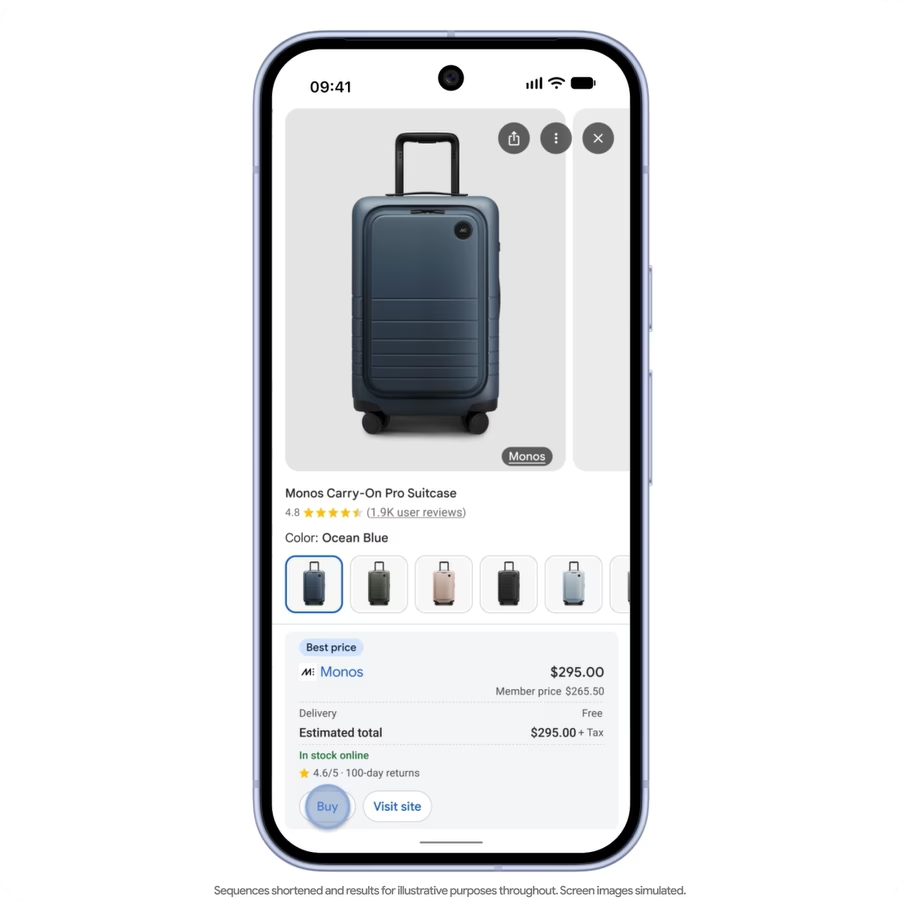
Someone asks AI Mode "find a lightweight suitcase for my upcoming trip." The AI shows products, the user says "buy the blue one," and UCP handles the entire transaction. Inventory check, payment processing with Google Pay (PayPal coming soon), order confirmation, all without opening a new tab.
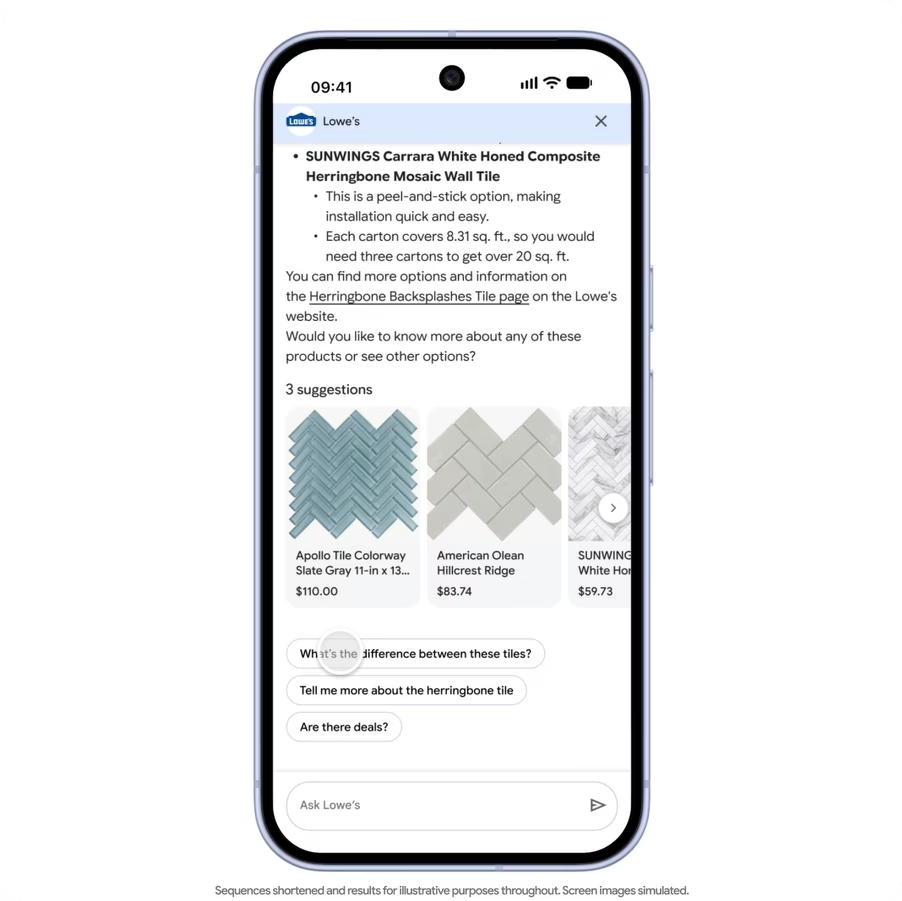
The checkout happens inside the AI interface. Retailers remain the seller of record and can customize the integration, but the customer never visits your site.
Why This Matters for Google Ads Campaigns
BCG estimates 15-20% of e-commerce transactions will be AI-mediated by 2028. Data from late 2025 already shows traffic from AI sources converts 40-60% worse than traditional search traffic because users get their answers without clicking through.
With UCP, that traffic might disappear entirely. Users complete purchases without visiting your website, which means:
- Your conversion funnel disappears. You can't retarget based on cart abandonment, can't run exit-intent popups, can't offer last-minute discounts at checkout. The AI handles all of that.
- Product data quality becomes critical. The AI decides which products to show based on structured data in Google Merchant Center. Detailed descriptions, accurate attributes, high-quality images, and proper schema markup determine whether your products surface in recommendations.
- Traditional SEO stops working for product discovery. When users shop through AI conversations instead of search queries, ranking for "best running shoes under $100" doesn't help if your product feed lacks the attributes the AI needs.
Direct Offers: Dynamic Discounts in AI Mode
Alongside UCP, Google launched Direct Offers as a pilot program for Google Ads. This lets advertisers present exclusive discounts to shoppers when the AI detects they're ready to buy.
Someone searches for a dining room rug. AI Mode shows several options from different retailers. One retailer has activated Direct Offers and configured a 20% discount for this product category. The AI displays that exclusive offer directly in the response: "This one is 20% off if you buy now."
The mechanic is simple: retailers set up offers in campaign settings, Google's AI determines when an offer is relevant, and it displays alongside product recommendations.
This matters because it changes where bidding happens in Google Ads. You're not just bidding for ad placement, you're bidding for the right to show a discount at the exact moment the AI determines someone is purchase-ready.
Early data from Google suggests these contextual offers convert significantly better than traditional Shopping ads because they appear precisely when user intent peaks. The challenge is you won't know exactly when your offers trigger, and you can't A/B test different discount levels through the interface yet.
Performance Max A/B Testing Launches in Beta
Google quietly expanded asset-level A/B testing to all Performance Max campaigns on January 9, 2026. Previously limited to retail campaigns, you can now test creative combinations within single asset groups across all campaign types.
The functionality lets you divide assets into three categories:
- Control group: Your existing assets serving as the baseline
- Treatment group: New assets you want to test against control
- Common assets: Elements that serve to 100% of traffic alongside both test variations
Tests run for a minimum of 4-6 weeks to account for Performance Max's learning phase. Google's Experiment Guidance System calculates required duration based on campaign characteristics.
This addresses one of the biggest complaints about Performance Max since launch: you couldn't isolate what was actually working. Asset-level reporting showed which headlines or images Google favored, but you couldn't control the test to prove causation.
This changes optimization because before, if you wanted to test a new creative approach in Performance Max, you'd duplicate the entire campaign or create a new asset group and wait weeks to see which performed better. Now you can test within a single asset group while maintaining all the campaign's learning and historical data.
The limitation is you can only test one asset group at a time per experiment, and assets lock during testing. You can't edit, add, or remove anything until the experiment ends.
What Else Changed in January
AI Overviews Ads Expanded Globally
Google expanded ads in AI Overviews to 11 new countries beyond the United States on December 19, 2025. The feature now works in Australia, Canada, India, Indonesia, Kenya, Malaysia, New Zealand, Nigeria, Pakistan, Philippines, and Singapore on both mobile and desktop.
Ads can appear within the AI-generated overview or above/below it. Only Text and Shopping ads from existing Search, Shopping, and Performance Max campaigns are eligible.
Detection of these ads in live environments remains extremely low. Adthena documented just 13 instances across 25,000 monitored SERPs in November 2025, a 0.052% frequency. Expansion to 12 countries suggests Google is preparing for broader rollout, but current impression volume appears minimal.
Call-Only Ads Deprecation Timeline
Google announced in October 2025 that Call-Only Ads are being phased out:
- February 2026: All options to create new call-only ads will be removed
- February 2027: Existing call-only ads stop receiving impressions entirely
The replacement is Responsive Search Ads with call assets. If you're running call-focused campaigns for local services, healthcare providers, or any business where phone leads are primary conversions, you need to transition now.
The technical mechanics remain similar. Click-to-call functionality, call tracking, bid adjustments, just the format shifts from standalone call ads to call assets attached to responsive search ads.
How to Prepare for Agentic Commerce
If you sell products online, here's what to do now:
- Audit your Google Merchant Center feed. UCP relies entirely on structured product data. Check that every product has complete attributes, accurate descriptions, high-resolution images, and proper categorization. Missing data means your products don't surface in AI recommendations.
- Add schema markup on product pages. Even though users might not visit your site, structured data helps AI systems understand your products. Use Product schema with price, availability, reviews, and detailed specifications.
- Keep running normal campaigns. UCP handles maybe 1-3% of transactions right now. Your Performance Max campaigns and standard Shopping ads still drive the bulk of revenue. Test new formats but don't abandon what works.
- Watch your attribution closely. Conversions through UCP will appear in Google Ads reporting, but the customer journey looks completely different. Someone who would normally click three times before buying might convert on first interaction through AI Mode. Your cross-channel analytics need to account for AI-assisted purchases appearing with different patterns.
OpenAI launched Instant Checkout in ChatGPT in September 2025. Microsoft rolled out Copilot Checkout through Shopify in early January 2026. Google's UCP is the third major commerce protocol in four months.
The pattern is clear: AI platforms are building native shopping functionality so users never leave the interface. Every major LLM provider is racing to become the purchase completion layer between consumers and merchants.
For advertisers, this creates a paradox. You still need to bid for visibility in Google Ads, but the signals you've relied on for a decade, click behavior, time on site, pages per session, cart abandonment patterns, stop working when transactions happen inside AI interfaces.
The solution isn't to panic and restructure everything. It's to run parallel strategies: optimize for traditional channels while building expertise in AI-native formats. Test Direct Offers when you get access. Improve product data quality. Monitor how much traffic shifts to AI Mode versus traditional Search.
But keep running the campaigns that work today. Agentic commerce might represent 20% of total e-commerce by 2028, which means 80% still happens the old way.
Google also updated analytics tools with Gemini this week. See how GA4's new cross-channel budgeting works. And if you want to simplify your Google Ads reporting, Dataslayer automates data delivery to Google Sheets, Looker Studio, and BigQuery. Start your 15-day free trial.



