



800 million weekly ChatGPT users can now complete purchases without leaving the conversation. Launched in late 2024, the Agentic Commerce Protocol connects merchants directly to ChatGPT's interface: no website visits, no external checkout pages. Etsy and over 1 million Shopify merchants already process real orders this way. OpenAI announced the launch alongside Stripe, making ChatGPT shopping available to all US users. If you sell products online, this is a new sales channel you need to understand.
ChatGPT Shopping vs. Traditional E-commerce
What Is the Agentic Commerce Protocol?
The Agentic Commerce Protocol (ACP) is an open-source standard that OpenAI and Stripe built together. It's not a plugin or integration; it's a protocol that any AI agent and any payment processor can implement.
Three things make it different:
- You stay in control. You're the merchant of record. You decide what to sell, how to price it, and how to fulfill orders. ChatGPT is just the interface where customers discover and buy.
- It works with your current systems. Whether you use Shopify, WooCommerce, BigCommerce, or custom infrastructure, ACP connects to your existing backend. You don't rebuild your payment processing or inventory management.
- It's open source. Released under Apache 2.0 license, meaning any company can implement it. You're not locked into OpenAI's ecosystem.
The protocol handles product discovery (ChatGPT finds your products when users ask relevant questions), checkout management (guides users through purchase), and secure payment processing through Shared Payment Tokens that protect customer credentials.
How It Actually Works
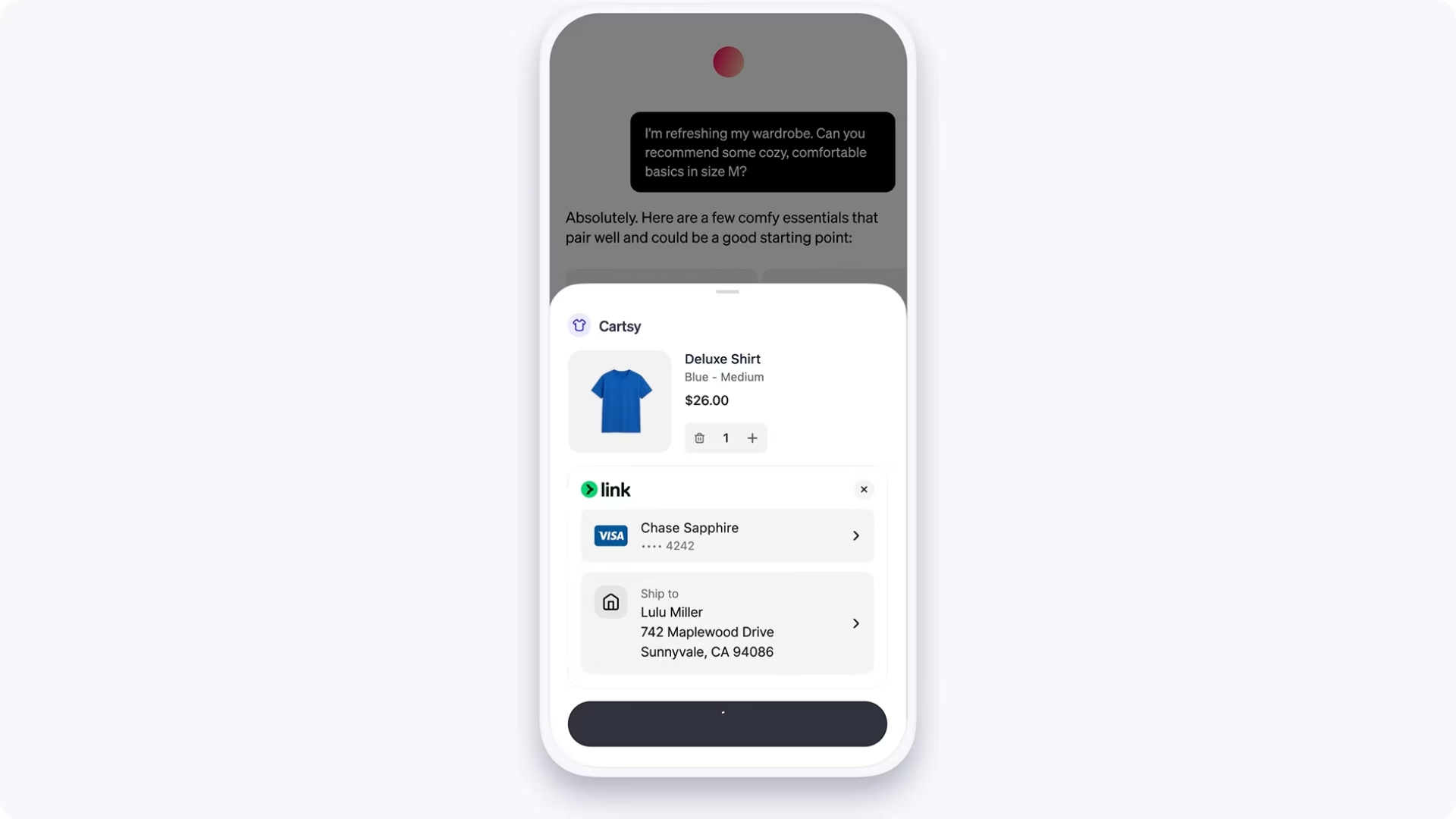
What Users See
- User asks: "running shoes under $100"
- ChatGPT shows 3 to 5 relevant products with images, prices, reviews
- User picks one: "the Nike Pegasus in size 10"
- ChatGPT collects shipping address (or uses saved info)
- User confirms payment method
- Done. Quick, conversational checkout.
What Happens Behind the Scenes
Your product feed. You provide ChatGPT with structured product data: SKUs, prices, descriptions, images, availability. Similar format to Google Shopping feeds.
Checkout request. When a user wants to buy, ChatGPT sends a CreateCheckoutRequest to your backend via REST API with product ID, quantity, and shipping location.
Shared Payment Token. Instead of passing raw credit card data, Stripe generates a Shared Payment Token, a one-time credential scoped to your specific merchant and transaction amount. This protects customer payment information.
You process payment. Your backend receives the token, charges the customer through your existing payment processor (Stripe or another provider using Stripe's Shared Payment Token API), and confirms the order.
You fulfill normally. From your operations side, it's just another order. You handle shipping, customer service, and returns exactly like web orders.
Who Can Sell on ChatGPT Right Now
Etsy sellers launched first, with over 1 million products available. Any US-based Etsy seller with an active shop can potentially surface in ChatGPT shopping queries.
Shopify merchants came next: Glossier, SKIMS, Spanx, Vuori, plus smaller merchants. Shopify's integration with the Agentic Commerce Suite makes setup relatively straightforward.
Platform merchants using Wix, WooCommerce, BigCommerce, or Squarespace can connect through Stripe integration. These platforms are rolling out native ACP support.
Coming soon (confirmed): URBN brands (Anthropologie, Free People, Urban Outfitters), Ashley Furniture, Coach, Kate Spade, Nectar, Revolve, Halara, Abt Electronics.
Geographic limit: US-only for merchants and customers. Expansion timeline unannounced.
How to Start Selling: Three Paths
Path 1: Stripe Users (Fastest)
If you already process with Stripe:
- Join Agentic Commerce Suite waitlist in your Stripe Dashboard
- Upload or sync your product catalog
- Select ChatGPT as distribution channel
- Implement ACP REST endpoints (Stripe provides templates)
- Test in sandbox
- Apply for ChatGPT Instant Checkout
Timeline: 1 to 3 weeks depending on catalog complexity.
Stripe merchants can enable agentic commerce by integrating their existing payment setup with the new protocol, often requiring minimal code changes.
Path 2: Non-Stripe Users
You can participate while keeping your current payment processor:
- Create Stripe account (only for token generation, not processing)
- Build product feed per OpenAI's Product Feed Spec
- Implement Agentic Checkout API with required REST endpoints
- Integrate Shared Payment Token for credential transmission
- Connect to your existing payment processor for transaction processing
- Apply for ChatGPT Instant Checkout approval
Timeline: 4 to 8 weeks depending on technical resources.
Path 3: E-commerce Platforms
Shopify, Wix, WooCommerce, BigCommerce, Squarespace are building native integrations.
For Shopify specifically:
- Ensure you use Shopify Payments or Stripe
- Install Agentic Commerce app when available
- Configure which products to list
- Map product taxonomy
- Test and launch
Timeline: 1 to 2 weeks once app is available (currently rolling out).
What This Means for Marketing Analytics
The big problem: users never visit your website.
Traditional journey: Google Ad, Landing Page, Product Page, Cart, Checkout
ChatGPT journey: ChatGPT Query, Instant Checkout, Done
Your website analytics don't capture this. Standard attribution models break.
New Metrics You Need
- ChatGPT-attributed revenue: Track which sales originated in ChatGPT
- Comparative AOV: Do ChatGPT orders have higher or lower average order value?
- CAC by channel: What's your customer acquisition cost specifically for ChatGPT?
- Return rate by channel: Do ChatGPT purchases have different return patterns?
- Query-to-purchase conversion: Which product queries actually convert?
How to Track It
Most ACP implementations include webhook notifications when orders are placed. Use these to:
- Tag orders with "ChatGPT" source in your order management system
- Send conversion events to Google Analytics, Mixpanel, or Amplitude
- Update customer records with acquisition channel
- Trigger attribution tracking in your data warehouse
If you're already pulling data from multiple sources (Google Ads, Meta, your e-commerce platform), you'll need to add ChatGPT order data to those reports. Many marketers consolidate this using data connectors that automatically sync multiple platforms to Google Sheets, Looker Studio, or BigQuery for unified dashboards.
For more on multi-channel tracking and AI-powered analytics, see: ChatGPT Agent Mode for Marketing Analytics: 10 Real Use Cases.
Learn more about preparing your marketing data infrastructure in our guide: ChatGPT Advertising 2026: Prepare Your Marketing Data Stack.
Common Implementation Problems
Problem 1: Bad Product Feeds
ChatGPT doesn't see your website design. It sees your product feed: title, description, price, category.
Bad: "Summer Vibe Dress, Shop Now!"Good: "Women's Cotton Midi Dress, Sizes 2 to 16, Navy Floral Print, Sleeveless"
ChatGPT matches products to queries using this data. Vague titles mean poor discovery.
Fix: Rewrite product data for clarity. Test by asking ChatGPT to describe your product based only on feed data. If it's vague, your feed needs work.
Problem 2: Out-of-Stock Items
ChatGPT's product index updates regularly but not instantly.
Problem: User tries to buy something you're out of.
Fix: Implement ACP's inventory webhook system. When stock changes, send an update. For fast-moving items, set safety thresholds. Don't list items with fewer than 3 to 5 units.
Note: Shopify and BigCommerce handle this automatically. Custom implementations require manual setup.
Problem 3: Price Mismatches
Your website shows 20% off but ChatGPT feed shows full price.
Fix: Keep pricing consistent or implement promotional pricing in your product feed. Most ACP implementations support promotional price fields.
Alternative: Use ChatGPT for full-price sales, reserve promotions for web retargeting.
Problem 4: Customer Service Confusion
Customer contacts support about their ChatGPT purchase. Your team has no context beyond order details.
Fix: Tag orders clearly: "ChatGPT, Instant Checkout" in your order system. Train support that customers may reference "what the AI said" or expect conversational support style.
Create a support macro: "I see you ordered through ChatGPT's Instant Checkout. Let me help you with that."
Problem 5: Returns Without Login
Your return process requires account login. ChatGPT buyers may not have web accounts.
Fix: Implement email-based returns. Include a direct return link in confirmation emails that works without credentials.
Is This Right for Your Business?
Strong Fit
Products with clear specifications: Electronics, sporting goods, home furnishings, books, beauty products with specific attributes (SPF level, dimensions, materials). AI can confidently match these to queries.
High search intent categories: Running shoes, laptop bags, kitchen appliances, skincare. If customers typically search "best X for Y" before buying, ChatGPT fits naturally.
Multi-channel sellers: Already on web, Amazon, Walmart Marketplace? ChatGPT is incremental, not transformational.
Well-documented catalogs: Detailed product data, clear categorization, attribute-rich feeds already exist.
Weak Fit
Highly visual products: Fashion where fit or style are subjective, art, custom goods, luxury items where visual browsing drives decisions.
Impulse purchase models: Revenue from users discovering products they didn't know they wanted. ChatGPT's Q&A format doesn't drive comparable browsing behavior.
Small catalogs with tight margins: Implementation requires technical resources. With 20 SKUs and razor-thin margins, ROI timeline may not justify effort yet.
Brand experience differentiation: If your advantage is website design, lifestyle branding, or editorial content, ChatGPT strips those away. You compete on product attributes alone.
The Hybrid Strategy
Many merchants treat ChatGPT as high-intent, late-stage conversion while keeping brand-building elsewhere:
- Instagram/TikTok: Brand awareness, visual discovery
- Google Shopping: Active comparison shopping
- ChatGPT: "I know what I want, help me buy it" conversions
Similar to how brands use Amazon (high-intent conversions) while maintaining their own sites (brand control, customer data).

The Connection to ChatGPT Advertising
OpenAI built commerce infrastructure first. They proved 800 million users trust buying inside ChatGPT. The next step, one OpenAI is actively hiring for, is paid discovery.
Internal OpenAI documents show $1 billion in projected "free user monetization" revenue in 2026. That almost certainly means advertising.
Why This Matters Now
Merchants who establish organic presence before paid placements launch get:
- Data advantage: 6 to 12 months showing which products work in conversational discovery, what queries drive purchases, how ChatGPT customers differ from web customers.
- Optimization advantage: Learn how to write for AI discovery (very different from SEO), what price points convert in chat, how to handle ChatGPT-specific support.
- Trust advantage: Users see you in both organic and sponsored results when ads launch.
- Cost advantage: Early adopters build baseline data when acquisition costs are lowest. Every new ad platform follows this pattern. Google Shopping, Facebook Marketplace, Amazon Sponsored Products all rewarded early movers.
For more on preparing for ChatGPT advertising, see: Beyond Plugins: How the Model Context Protocol (MCP) Is Changing ChatGPT.
FAQ
Can users actually buy products in ChatGPT right now?
Yes. Launched in late 2024. 800 million weekly users in the US can purchase from Etsy and Shopify merchants (Glossier, SKIMS, Spanx, Vuori) without leaving the chat. This isn't beta; it's live for ChatGPT Free, Plus, and Pro users. The feature works exactly as described: ask a question, get product recommendations, complete checkout in the same conversation window.
How do I get my products listed on ChatGPT?
Stripe users: Join Agentic Commerce Suite waitlist in Stripe Dashboard, upload catalog, select ChatGPT as channel. Setup can be done in a few hours if your product data is already organized.
Platform users (Shopify, Wix, etc.): Watch for native integration from your platform. Shopify merchants are being onboarded in phases throughout early 2026.
Others: Implement the open-source ACP spec and use Stripe's Shared Payment Token API. This path requires developer resources but gives you full control.
Do I need to switch to Stripe to sell on ChatGPT?
No. The protocol is processor-agnostic. You can use Stripe's Shared Payment Token API for secure credential transmission while processing payments through PayPal, Square, Adyen, or your current provider. Stripe acts as a security layer, not your payment processor. You keep your existing merchant account, fee structure, and settlement terms.
What customer data do I get from ChatGPT orders?
Name, shipping address, email, order details, same as any channel. You're the merchant of record, so the customer relationship is directly with you. You don't get conversational context (what they asked ChatGPT) or browsing behavior since they never visit your site. Tag these orders as "ChatGPT" in your system so you can analyze performance separately from web, Amazon, or retail.
How much does it cost to sell on ChatGPT?
No ChatGPT-specific fees. You pay standard payment processing (typically 2.9% plus $0.30) and platform fees (Shopify, WooCommerce, etc.). OpenAI doesn't charge merchants to list products or complete transactions, at least not yet. This may change when paid advertising launches, but organic product discovery remains free.
Can I sell on ChatGPT if I'm outside the United States?
Not yet. As of January 2026, Instant Checkout only works for US merchants selling to US customers. OpenAI confirmed expansion is planned but hasn't announced markets or dates. If you're international, you can still prepare by implementing ACP infrastructure now, so you're ready when your market opens.
Does ChatGPT shopping work on mobile?
Yes. The ChatGPT mobile app (iOS and Android) supports Instant Checkout with the same functionality as desktop. Mobile users can discover products, view recommendations, and complete purchases entirely in-app. Given that mobile represents a substantial portion of ChatGPT's 800 million weekly users, this is significant for conversion potential.
Getting Started: Your Implementation Checklist
If you're ready to sell on ChatGPT, here's a practical approach:
Phase 1: Assessment
- Review catalog for AI-compatibility (clear specs, searchable attributes)
- Check payment processor (Stripe means faster path)
- Analyze current customer acquisition costs across channels for baseline
- Read official ACP documentation
Phase 2: Technical Prep
- Audit product feed quality (titles, descriptions, categories)
- Identify technical resources (developer time, API access, testing)
- Review order system's ability to tag acquisition channels
- If platform user: Contact Shopify or WooCommerce about timeline
Phase 3: Infrastructure
- Join Stripe Agentic Commerce Suite waitlist (if applicable)
- Build product feed per OpenAI spec
- Set up webhooks for inventory and orders
- Create "ChatGPT" tracking tags in analytics
Phase 4: Testing & Launch
- Test checkout in sandbox environment
- Apply for ChatGPT Instant Checkout
- Train customer service on conversational commerce
- Set up monitoring dashboards for ChatGPT orders
Ongoing: Optimization
- Monitor which queries drive conversions
- Compare ChatGPT versus web customer behavior (AOV, returns, repeat rate)
- Refine product descriptions based on AI discovery patterns
- Prepare for multi-item carts, new markets, potential ads
Merchants starting this process in early 2026 will have 6 to 12 months of conversion data before ChatGPT advertising potentially launches later this year. That head start compounds.
Conclusion
ChatGPT shopping is live, processing real orders, reaching 800 million users. Learning how to sell on ChatGPT now means you'll have months of optimization data before competitors catch up, and before ChatGPT advertising potentially launches later this year.
If you need to track ChatGPT orders alongside Google Ads, Meta, and other channels in unified dashboards, Dataslayer connects 50+ platforms to Google Sheets, Looker Studio, BigQuery, and Power BI. When ChatGPT becomes a significant revenue channel, adding it to your existing reports is just one more data source. Try free for 15 days.



