



The marketing playbook you used in 2024 won't work in 2026. Not because of incremental improvements, because the rules changed.
After analyzing forecasts from Gartner, Kantar, and Forrester, six marketing trends 2026 predictions appear in nearly every industry report:
1. AI Agents Make Decisions Without You
Gartner predicts 40% of enterprise applications will include AI agents by end of 2026, with the autonomous AI market expected to hit $11.79 billion. These aren't chatbots. They're systems that allocate ad budgets, adjust targeting, and optimize campaigns without human prompts.
Your Meta campaigns already adjust bids automatically. By 2026, that automation extends to creative selection, audience discovery, and cross-channel budget allocation. The AI doesn't wait for your approval, it acts on patterns you haven't spotted yet.
What you need:
- Clean data architecture (AI makes bad decisions with messy data)
- Clear governance rules (set boundaries before giving AI control)
- Testing environments separate from production campaigns
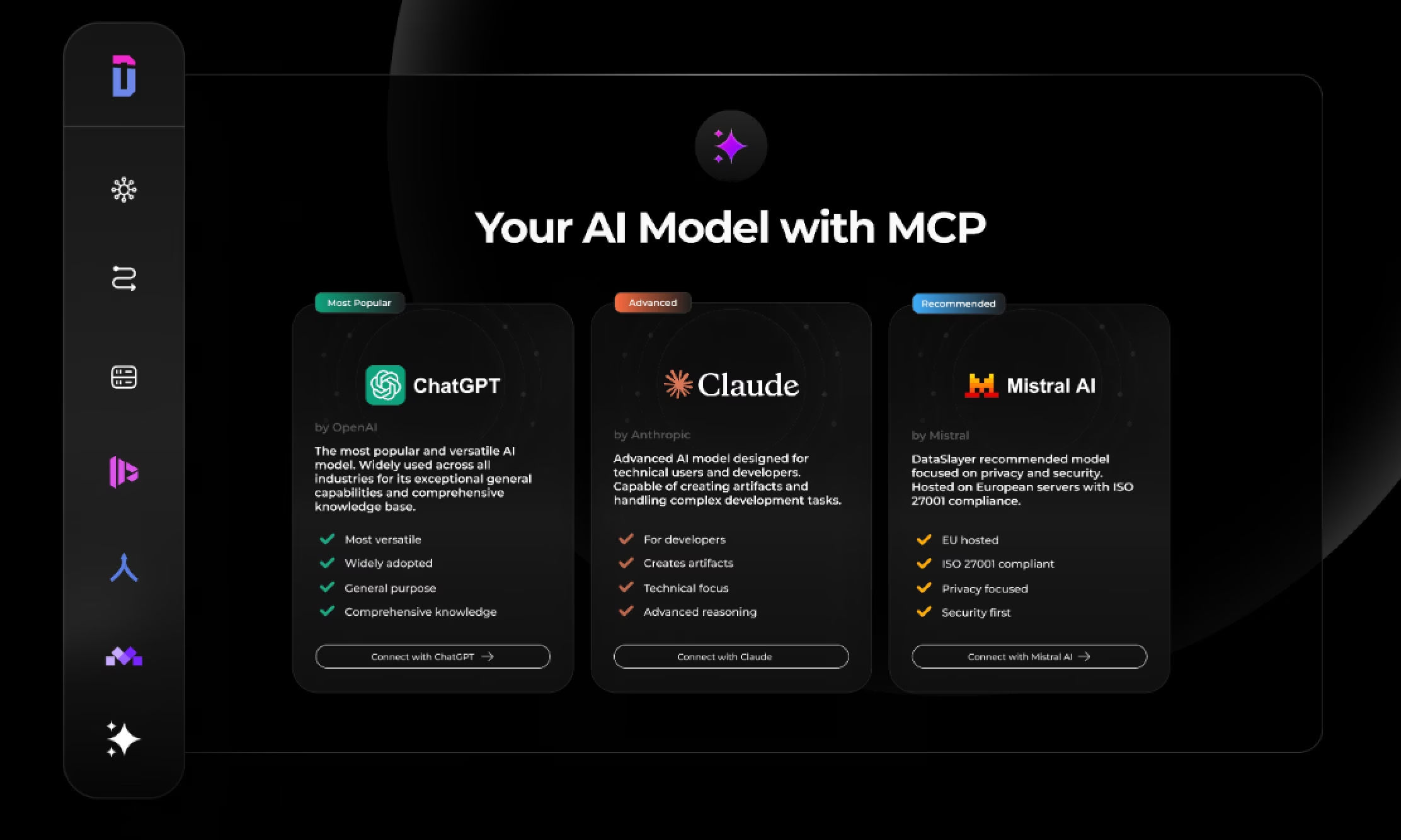
- AI agents that can actually access your marketing data (tools like Dataslayer's MCP integration let ChatGPT query your campaigns directly, no manual exports)
Most marketing teams waste 5 to 10 hours weekly on tasks AI can handle. The question isn't whether to adopt agents, it's which decisions you're comfortable delegating.
2. First-Party Data Became Non-Negotiable
75% of marketers expect third-party data limitations to disrupt operations in 2026, according to Celebrus research. The "cookieless future" arrived, and guessing stopped working.
What actually works:
- Interactive calculators that require email to save results
- Private communities exchanging value for information
- Progressive profiling across touchpoints
What doesn't: Newsletter gates before showing any value.
If you run Meta or Google campaigns, implement Enhanced Conversions and Advanced Matching now. Your pixel data quality directly determines how well AI optimizes. Marketing data integration becomes infrastructure, not a nice-to-have.
3. Retail Media Hits 20% of Digital Ad Spend
US advertisers will spend $69.33 billion on retail media in 2026, up from $58.79 billion in 2025, according to eMarketer projections. That's not a trend, it's a redistribution of where ads work.
Retail media networks deliver 1.8x better results than standard digital ads and nearly 3x higher purchase intent, according to Kantar data, because they combine purchase-ready audiences with transaction data and closed-loop attribution.
But Amazon and Walmart capture 89% of incremental spend. If you're in CPG, you're already moving budgets there. If you're not in CPG, test with $5K to $10K monthly to learn the platforms before competitors do.
4. SEO Split Into Two Disciplines
25% of search queries will go through generative AI by 2026, according to Gartner predictions, and some publishers already report 40% traffic drops from Google's AI Overviews. The game changed from ranking #1 to being the answer AI cites.
Quick GEO wins:
- Add schema markup for organization, products, authors
- Structure content as Q&A that answers complete question chains
- Create "how we evaluate [category]" pages explaining your methodology
- Include citations to authoritative sources (AI trusts sourced content)
You need both. Traditional SEO still drives massive traffic. GEO positions you for where discovery moved.
5. 24% Already Shop With AI Assistants
Kantar research shows 24% of AI users already rely on AI shopping assistants, and 74% regularly seek AI-driven recommendations. This isn't future speculation, it's happening on ChatGPT, Perplexity, Amazon's Rufus, and Walmart's Sparky.
Consumers brief AI agents ("find mascara for sensitive skin under $20"), and those agents become autonomous as payment integrations improve.
What you need:
- Product specs and comparisons in structured formats
- Content that demonstrates E-E-A-T (expertise, experience, authority, trustworthiness)
- FAQ content addressing entire question chains, not just first queries
Example: When someone asks "What's the best CRM for small businesses?", they'll next ask "How much does it cost?" and "What integrations exist?" Address all three.
6. MarTech Stacks Consolidate Into Decision Platforms
68% of CMOs find their martech investments underutilized due to fragmentation, according to Gartner 2024 research. Companies finished paying for 30 to 50 tools that barely connect.
Organizations consolidating their stacks achieve 23% to 28% faster campaign deployment and 35% higher data accuracy, according to Intent Amplify analysis.
The market split into two modes:
- The Laboratory: Test new AI agents and experimental campaigns
- The Factory: Production-grade automation and core systems
What's dying: Batch-era tools assuming overnight data processing and sequential workflows. If your marketing automation can't make real-time decisions, it's on borrowed time.
What wins: Composable architectures where your CRM or data warehouse is the single source of truth, surrounded by specialized tools connecting via APIs.
Marketing report automation helps consolidate data when you're pulling metrics from multiple platforms. You can handle this manually with exports, or automate the connections to your reporting tools.
How to Actually Prepare
Fix your data foundation first:
- Audit what first-party data you collect and where it lives
- Implement server-side tracking (Conversions API for Meta, enhanced conversions for Google)
- Connect your email platform to your CRM for a single customer view
Test AI in controlled environments:
- Use ChatGPT or Claude for research and competitive analysis
- Pilot AI creative testing tools that predict ad performance pre-launch
- Let platform automation handle more, Meta's Advantage+ and Google's Performance Max improved significantly
Build GEO alongside SEO:
- Add schema markup to 10 key pages this quarter
- Reformat top blog posts into structured Q&A formats
- Create methodology pages explaining evaluation criteria
Experiment with retail media if relevant:
- Allocate 10% to 15% of digital budget to test Amazon Ads or Walmart Connect
- Focus on high-intent keywords where you have competitive advantages
- Track incremental lift, not just ROAS (attribution works differently)
The Bottom Line
These aren't predictions, they're data from companies already running pilots. The difference between 2026 winners and everyone else won't be budget size. It'll be who adapted their data infrastructure, AI governance, and discovery strategy before competitors figured out the game changed.
You don't need to overhaul everything tomorrow. Pick two marketing trends 2026 aligning with your biggest pain points and start testing this quarter. ChatGPT prompts for marketing analytics can help accelerate your AI adoption without requiring custom development.
What's your 2026 priority: AI agents, first-party data, or visibility in AI search? Companies acting now will define the playbook everyone copies next year.



