


Did your Meta Ads conversion numbers drop 30-40% on January 12? Or did some campaigns completely stop delivering on January 15?
Meta made two major API changes in mid-January 2026 that broke attribution tracking and targeting for thousands of advertisers. If you weren't watching the Developer Blog, your reporting changed overnight without warning.
The Attribution Window Changes (January 12)
Meta permanently removed longer view-through attribution windows from the Ads Insights API. This is the biggest change to Meta ads attribution in years.
What Meta removed:
- 7-day view attribution
- 28-day view attribution
- All combined windows using these (7-day click + 28-day view, etc.)
What still works:
- 1-day view (the only view window remaining)
- 1-day click, 7-day click (for people who clicked)
- 28-day click (reporting only, not for optimization)
Meta announced these attribution window changes in October 2024, giving three months notice. But most advertisers missed it.
Your ads didn't suddenly perform worse. You're just seeing fewer attributed conversions because the measurement window shrunk from 28 days to 1 day.
Industry data shows that some advertisers had 30-40% of conversions coming from that 8-28 day window that no longer counts.
Why These Attribution Changes Matter
For awareness campaigns: If you run video ads or display campaigns where people rarely click immediately, you relied on view-through attribution to show value. Someone sees your ad Tuesday, doesn't click, searches your brand Friday and buys. That conversion used to count within the 7-day view window. Now it doesn't.
For direct response: Less impact here. If people click and buy immediately (promotions, retargeting), most conversions already happened within 1-7 days.
For B2B with long sales cycles: Your conversion counts now look artificially low. The prospect who saw your ad, researched for two weeks, then converted? That attribution is gone.
The Targeting Changes (January 15)
Three days after the attribution changes, Meta stopped delivering campaigns that used discontinued targeting options.
Campaigns created before June 23, 2025 using specific interests that Meta consolidated stopped running on January 15 unless updated.
What Meta did: Merged hundreds of granular interests into broader categories. "Jazz Guitar" became "Jazz Music." "Vintage Sci-Fi Films" folded into general entertainment. Sports sub-interests, specific car models, niche food preferences, all consolidated.
Check if you're affected:
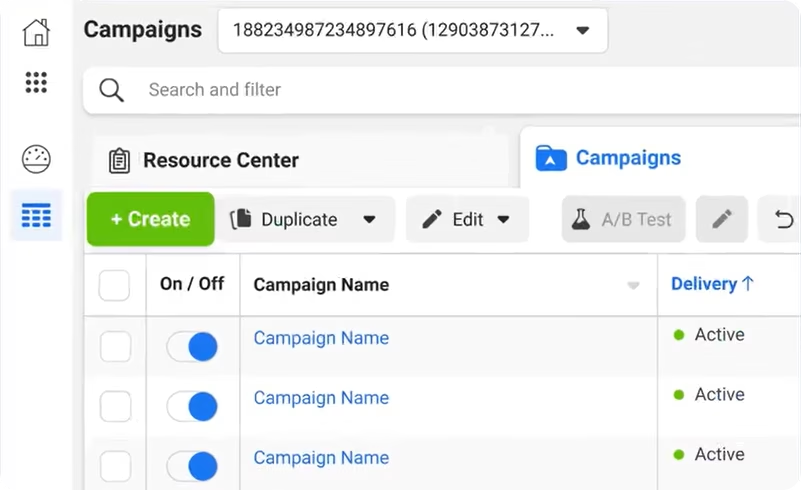
- Open Meta Ads Manager
- Look for black banner: "Some detailed targeting options have been combined"
- Click "See affected ad sets"
- Any ad set listed isn't running
You must edit each ad set, remove discontinued targeting, and replace with Meta's suggested alternatives. Ads won't restart until you do this.
The EU Privacy Requirement (Rolling Out Now)
Meta is giving EU users choice about ad personalization after the €200 million fine for violating the Digital Markets Act. The European Commission announced Meta will present three options to EU users through January 2026:
- Fully personalized ads (consent to full data sharing)
- Less personalized ads (limited data, context-based targeting)
- Ad-free paid subscription (€10-13/month)
If significant EU users choose option 2, your targeting becomes less effective for those users. Meta won't use their full activity history across Facebook, Instagram, Marketplace, and WhatsApp.
We won't know real impact until Q1 2026 when we see how many users opt out.
Three New Features That Help
Business AI Breakdown shows which conversions came from Meta's automation: Advantage+ creative, automatic text optimization, delivery optimization. Before this, AI optimization was invisible.
Conversion Count Breakdown separates first-time converters from repeat customers. If 80% are repeat conversions, you're mostly reaching existing customers, not new ones.
Partnership Ads improvements added AI recommendations. The data is real: 19% lower CPA and 13% higher CTR compared to standard ads, according to Meta's December 2025 data.
How to Fix Attribution Reporting After Meta's Changes
Set new benchmarks:
Pull data from November-December 2024 with both 1-day and 7-day view windows. Calculate: (1-day view conversions) ÷ (7-day view conversions).
If you historically saw 100 conversions with 7-day view but only 65 with 1-day view, your ratio is 0.65. When you see 80 conversions now with 1-day view only, your adjusted equivalent is about 123 conversions using the old window.
This doesn't change costs, but helps you compare performance trends accurately. Understanding how Meta counts conversions differently matters more than ever with shortened attribution windows.
Fix broken API calls:
If you pull Meta data into external reports (Google Sheets, Looker Studio, Power BI, data warehouses), your API calls need updating. Any request for "7d_view" or "28d_view" now returns empty data.
- Manual exports: Change attribution windows in Ads Manager before exporting
- Native connectors: Most updated automatically (check documentation)
- Custom API integrations: Update
action_attribution_windowsparameter
If you're combining Meta with other platforms, these attribution window changes make cross-platform analysis trickier. GA4 and Meta already measured conversions differently, now that gap got wider.
Track Meta Ads Conversions in Looker Studio
Compare pre- and post-attribution change performance side by side. Our free Meta Ads dashboard pulls data directly from the API — no manual exports, no broken windows. See the real impact on your CPA and ROAS.
Fix Stopped Campaigns Right Now
For campaigns that stopped delivering:
Go to Ads Manager, click "See affected ad sets" in the warning banner, then edit each one. Remove discontinued targeting options and replace with Meta's suggestions. Test for 3-5 days, then refine based on performance.
Start with Meta's alternative suggestions rather than deleting targeting entirely.
Adjust Your Creative Strategy
Since granular targeting disappeared, creative needs to do more work.
Old approach: Target "Women 25-34 interested in organic skincare" + generic creative
New approach: Target "Women 25-34 interested in health and wellness" + creative that specifically calls out organic skincare benefits
The targeting got broader, so ad copy needs to pre-qualify the right people. Use hooks like:
- "Tired of synthetic ingredients in your skincare?"
- "If you read ingredient labels, you need to see this"
- "Looking for certified organic face cream?"
This self-selects your actual audience when Meta's targeting is less precise.
Monitor EU Campaigns Through Q1 2026
If you advertise in Europe, watch these metrics as privacy options roll out:
- CPM (might increase if addressable audience shrinks)
- CTR (might decrease if targeting becomes less precise)
- Conversion rate (shows if you're reaching less-qualified users)
If you see significant drops:
- Create separate ad sets for EU vs. non-EU
- Use more first-party data (customer lists, website visitors)
- Test Partnership Ads (rely on content quality over granular targeting)
What Changed vs. What Stayed the Same
What Meta's Attribution Changes Mean Long-Term
Meta's been doing this all year. Killing manual controls, shrinking attribution windows, pushing automation. The pattern is clear from 83 platform changes in 2025: remove granular controls, force faster optimization, improve automation tools, make reporting transparent.
If you're still running campaigns with 2019 tactics (manual bidding, hyper-specific audiences, constant tweaking), these attribution window changes just forced your hand.
What works now:
- Broader audiences with stronger creative
- Let Meta's AI handle more optimization
- Use your customer data over platform interest targeting
- Test Partnership Ads for better CPAs
- Accept imperfect attribution, track business results alongside platform metrics
Action Steps for This Week
First, check Ads Manager for the targeting warning banner. Click through and update affected ad sets before more time passes.
Second, pull historical attribution data to set new benchmarks. You need baseline numbers with the shorter attribution window.
Third, if you have creator content or customer testimonials, test one Partnership Ad. The 19% lower CPA data is real.
Fourth, document EU campaign performance now to spot privacy-related changes as they happen.
These aren't minor adjustments. Meta changed how attribution works and which targeting you can use. Two core foundations of platform advertising. Advertisers who adapt quickly waste less money on broken campaigns and misread data.
If you need help managing Meta Ads reporting Dataslayer connects Meta to Google Sheets, Looker Studio, BigQuery, or Power BI. Try it free for 15 days.
Frequently Asked Questions
What attribution windows does Meta Ads support after January 2026?
Meta now supports only 1-day view and 7-day click as the default attribution window. The 7-day view and 28-day view options were permanently removed from the Ads Insights API in January 2026. You cannot request longer view-through windows even via the API.
Why did my Meta Ads conversion numbers drop suddenly?
If your conversions dropped around January 12, 2026, it is likely due to the attribution window change. Conversions that previously counted within a 7-day or 28-day view window are no longer attributed. This mostly affects awareness and video campaigns where users see an ad but convert later without clicking.
How do I track Meta Ads conversions accurately after the attribution change?
Pull data from November-December with both old and new attribution settings to establish a baseline. Compare the difference to calculate your attribution gap. Then use Looker Studio with Dataslayer to build dashboards that track the new 1-day view and 7-day click windows alongside GA4 data for a complete picture.
Does the Meta attribution change affect all ad types equally?
No. Direct response campaigns with immediate clicks and purchases are least affected. Awareness campaigns, video ads, and B2B campaigns with longer sales cycles are most impacted because they relied heavily on view-through attribution windows longer than 1 day.
Can I still see 7-day view attribution data from before January 2026?
Historical data from before January 12, 2026 that was recorded with the old attribution windows is still accessible. However, any new data requests will only use the current 1-day view and 7-day click windows. You cannot retroactively apply the old windows to new data.



