

In 2024, we explored the best Supermetrics alternatives, and last year we updated the picture for 2025. Now, in 2026, the market has shifted again. Funnel.io raised prices in February, several platforms repositioned around AI-powered data workflows, and warehouse-native tooling has matured into a default expectation rather than a premium add-on.
Industry research consistently points to the same shifts. Gartner's 2026 CMO Spend Survey shows CMOs allocating 15.3% of marketing budgets to AI, raising the bar on data-quality and integration reliability for any tool in the stack. Analyst commentary from eMarketer and the Forrester Wave for Revenue Marketing Platforms (Q1 2026) both point to consolidation and pricing transparency as the dominant themes shaping vendor selection this year.
Updated June 2026 with the latest pricing, vendor changes, and a decision rubric. For the most up-to-date comparison with transparent pricing tables, see our 12 Supermetrics competitors guide.
This guide is written for marketers and analysts who already know what Supermetrics does and want to know which alternative actually fits their use case. Each of the ten tools below includes three pros, two to three cons, and the type of team it suits best. At the end, you will find a comparison table, a decision rubric by team size and budget, a market-change recap, and an eight-question FAQ.
Why teams are looking for Supermetrics alternatives in 2026
Supermetrics built its reputation as the default sidecar for Google Sheets and Looker Studio, and it still serves that role well for many teams. The reasons marketers shop around in 2026 are not about the product being bad. They come down to four forces operators are feeling at the same time.
1. Pricing pressure on mid-market budgets. the Gartner 2026 CMO Spend Survey shows marketing budgets remain flat at 7.8% of company revenue, and 56% of CMOs say they lack the budget to deliver their 2026 strategy. Teams need more from each dollar, and the gap between Supermetrics' entry tier and what a Dataslayer or Windsor.ai plan delivers at the same price has widened.
2. Warehouse-native is now baseline. BigQuery, Snowflake, and Redshift destinations were premium add-ons in 2023. In 2026 they are table stakes. Tools that still treat warehouse delivery as an upsell feel dated.
3. AI features that actually decide something. Every vendor markets "AI-powered" workflows. The differentiator is whether the AI runs anomaly detection, suggests budget reallocations, or flags broken connectors before reports break. Tools that ship decision-grade AI win renewals.
4. Pricing transparency. G2 reviewers consistently flag opaque pricing as the top friction point in this category. Tools with published tiers (Dataslayer, Windsor.ai, Coupler.io, Porter Metrics) close deals faster than those gated by a sales call.
Today, we revisit the best Supermetrics alternatives, highlighting why Dataslayer stands out as the top choice for businesses and marketers looking for a robust and cost-effective data integration solution. At the end of this article, you'll find a comparison table that highlights the key features and pricing of each tool, helping you make a well-informed decision on the best Supermetrics alternative for your needs.
1. Dataslayer – The Best Supermetrics Alternative in 2026
If you're looking for a powerful yet affordable alternative to Supermetrics, Dataslayer remains the best option in 2026. This tool has grown significantly over the past two years, offering seamless integrations with Google Sheets, Microsoft Excel, Looker Studio, Power BI, BigQuery, Amazon S3, and Amazon RedShift, making it a go-to solution for marketers and analysts.
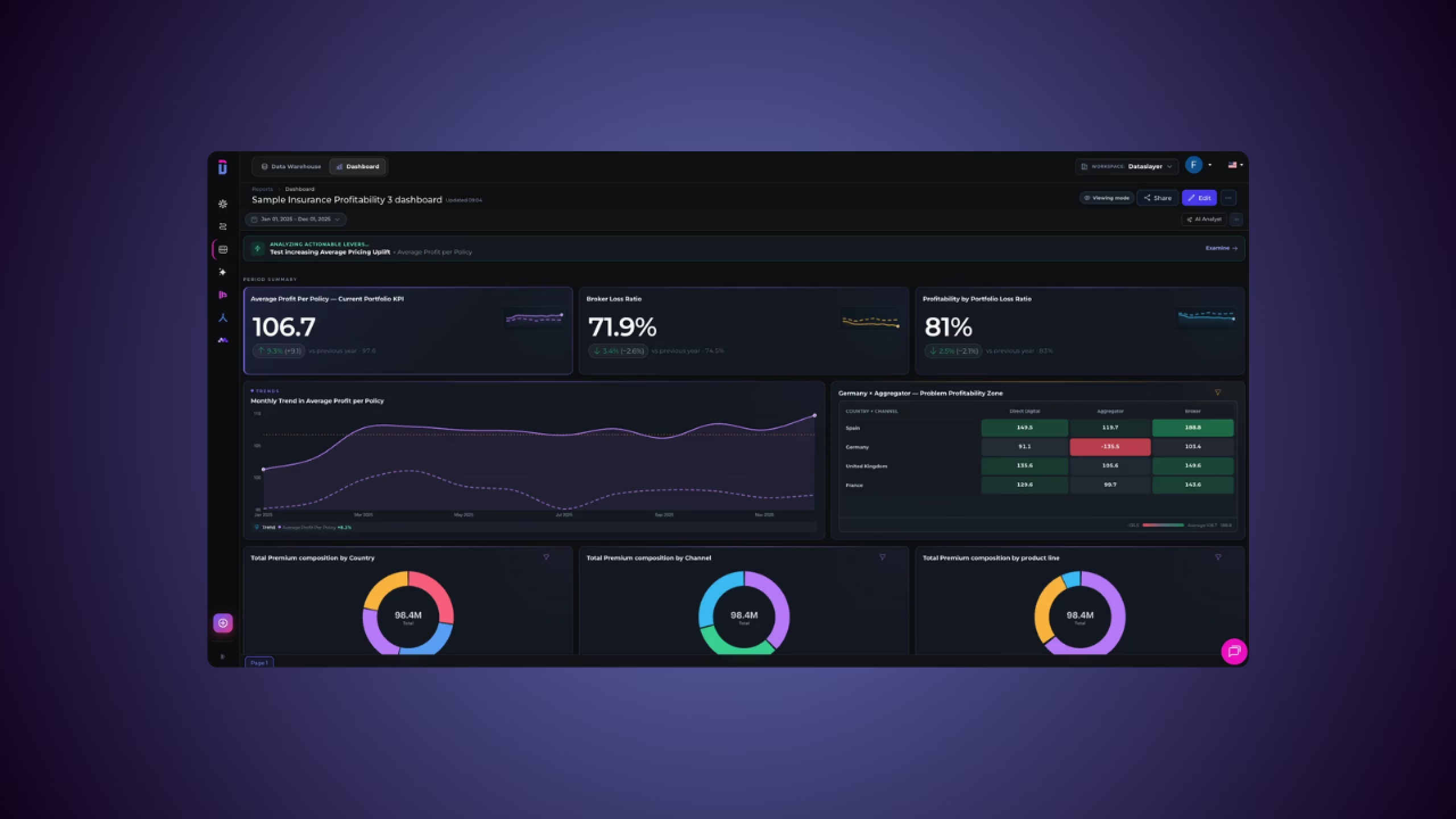
Additionally, Dataslayer's Marketing Mix Modeling platform, Morpheus, gives you insights into your marketing results so you can identify the channels that deliver the best results and re-allocate your marketing budget in a smarter, data-driven way. Throughout 2025 and into 2026, Morpheus has continued to add AI-driven optimization features for both online and offline campaigns.
Dataslayer pros
Dataslayer cons
Why Choose Dataslayer Over Supermetrics?


Morpheus: Dataslayer Marketing Mix Modeling Platform
Marketing Mix Modeling (MMM) is a data-driven approach that helps businesses understand the effectiveness of their marketing efforts by analyzing historical data and predicting future performance. Morpheus is an advanced AI-powered platform that enables marketers to optimize budget allocation, improve ROI, and gain deeper insights into their marketing strategies.
Morpheus utilizes AI and machine learning to evaluate the impact of various marketing channels, both online and offline, providing businesses with a holistic view of their campaigns. With seamless integration into multiple data sources, Morpheus helps companies streamline their decision-making process and improve marketing efficiency. With third-party cookies effectively gone in 2026, MMM moved from "nice to have" to a core part of any performance team's stack.
2. Improvado

Improvado remains a strong competitor in 2026, especially for large enterprises that require extensive data processing. It supports 500+ data sources, surpassing Supermetrics' 150+, and offers advanced ETL (Extract, Transform, Load) capabilities, making it ideal for complex marketing data needs. Its AI-driven transformation tools allow marketers to process and visualize data efficiently, which makes it a strong contender for enterprises seeking comprehensive data solutions, but at a higher price point compared to other competitors.
Improvado pros
Improvado cons
3. Funnel.io

Funnel.io is another enterprise-focused tool that serves as a Supermetrics alternative, designed for automating data collection and transformation. It integrates with multiple destinations, also supporting 500+ data sources, including data warehouses and visualization tools, making it a solid choice for data-heavy companies. Heads up: Funnel.io adjusted its pricing in February 2026, with the entry plan moving upward. Verify current rates before purchase. Its learning curve and pricing structure might not be ideal for all businesses.
Funnel.io pros
Funnel.io cons
4. Windsor.ai

For businesses looking for a more cost-effective option than Supermetrics, Windsor.ai offers a good balance between price and functionality. It supports integration with multiple data warehouses and provides unlimited integration with Google Sheets for 325+ data sources. This flexibility makes it suitable for businesses aiming to optimize marketing data management without incurring high costs. However, it lacks some of the deeper integration options that Dataslayer and Improvado provide, and its interface might not be as intuitive or aesthetically pleasing as those of certain competitors.
Windsor.ai pros
Windsor.ai cons
5. Coupler.io
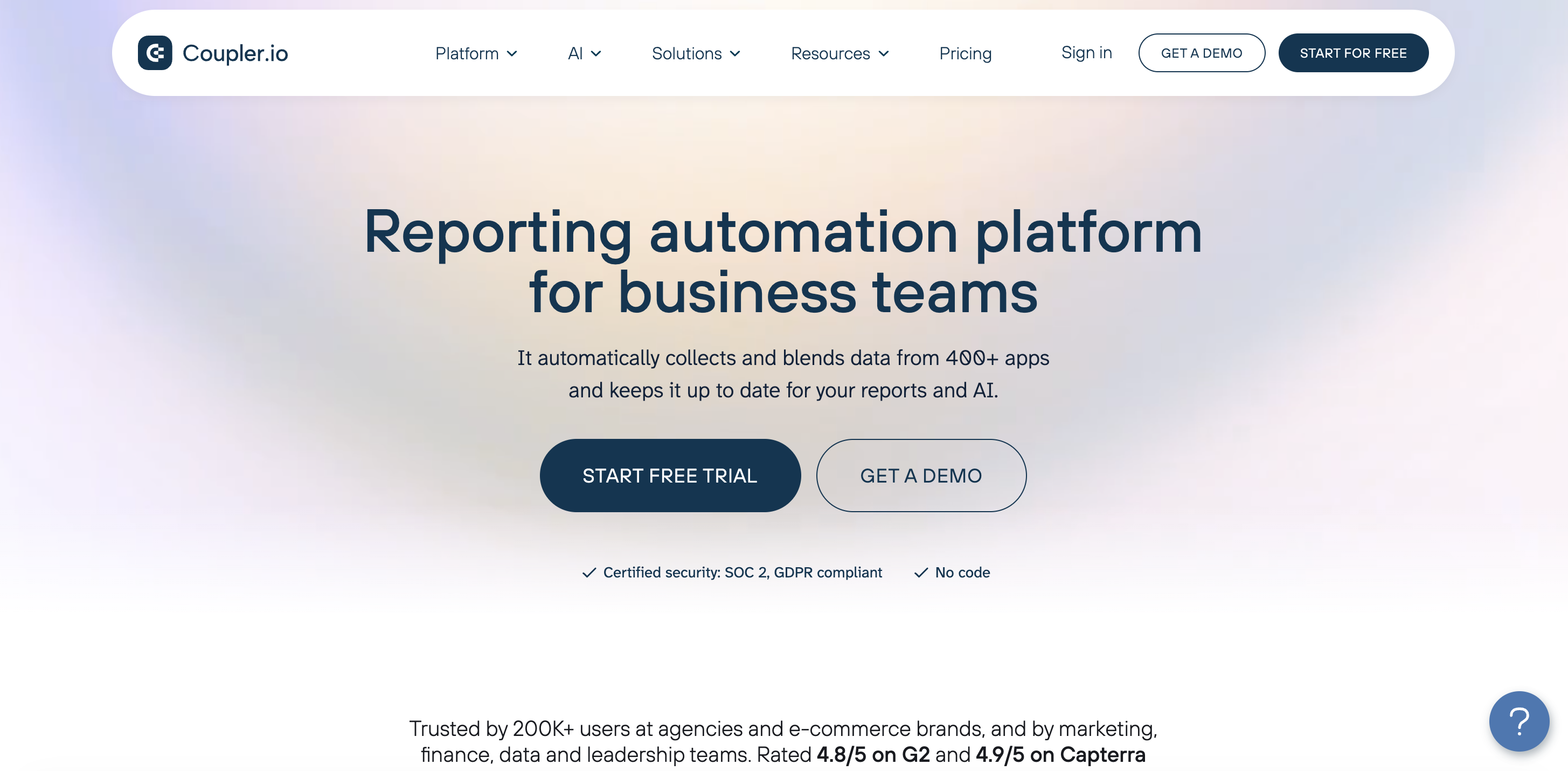
Coupler.io is a no-code data integration tool that connects 400+ business apps to destinations like Google Sheets, Excel, Looker Studio, Power BI and data warehouses, and more recently to AI tools via MCP. It covers marketing, sales and finance sources, includes basic transformations such as joins and aggregations, and offers dashboard templates. It’s a reasonable fit for small teams that want a quick setup, although the entry plan is limited in accounts, destinations and refresh frequency, so costs grow quickly as reporting needs scale.
Coupler.io pros
Coupler.io cons
6. Porter Metrics

Designed for medium-sized agencies, Porter Metrics is another Supermetrics alternative that provides easy-to-use reporting solutions, with pre-built dashboards and templates that streamline data visualization. It is a great choice for marketing teams but may not have the depth of integrations required by larger enterprises.
Porter Metrics pros
Porter Metrics cons
7. Adverity

A powerful AI-driven marketing analytics tool, Adverity is well-suited for enterprises looking to optimize and automate their data workflows at scale. It supports a wide array of integrations, but its complex setup and pricing may not be ideal for smaller businesses.
Adverity pros
Adverity cons
8. Whatagraph

Whatagraph focuses on data visualization and reporting, making it a preferred choice for agencies that need to create client-ready reports quickly. It offers drag-and-drop report creation and real-time data updates but is not as versatile when it comes to custom integrations.
Whatagraph pros
Whatagraph cons
9. Power My Analytics

For those looking for a pay-per-connector pricing model, Power My Analytics offers a budget-friendly way to integrate various data sources without committing to expensive subscription plans. However, its limited number of integrations and customization options may be restrictive for some businesses.
Power My Analytics pros
Power My Analytics cons
10. Agency Analytics

Agency Analytics is another option for those seeking a Supermetrics alternative ideal for marketing agencies managing multiple clients, offering customizable dashboards and automated reports tailored for agency workflows. However, it focuses more on reporting rather than deep data integration and transformation.
Agency Analytics pros
Agency Analytics cons
Supermetrics Alternatives Comparison Table
Each Supermetrics alternative offers unique strengths catering to different business needs. Some tools excel in affordability and ease of use, while others provide advanced automation, AI-powered analytics, or extensive integrations.
 Dataslayer |  Improvado |  Funnel |  Windsor |  Coupler |  Porter Metrics |  Adverity |  Whatagraph |  Power My Analytics |  Agency Analytics | |
|---|---|---|---|---|---|---|---|---|---|---|
| Pricing | from $29 | Custom pricing plans | from $200 (introduced at $400 Feb 2026, reduced to $200 March 2026) | from $19 | from $24 | from $12.49 | Custom pricing plans | from $229 (verified Jun 2026) | from $49.95 (Business, verified Jun 2026) | from $59 |
| Free Trial | 15 days | No | No | 30 days | 7 days | 14 days | No | No | 14 days | 14 days |
| Free Plan | Yes | No | Yes | Yes | Yes | No | No | No | No | No |
| # of Connectors | 45+ | 500+ | 500+ | 325+ | 400+ | 19 | 400+ | 55+ | 45+ | 80+ |
Data refreshed June 2026. Coupler.io data updated November 2026. 2025 entry-tier pricing carried forward where vendors have not publicly changed plans. Funnel.io raised its starting tier in February 2026. Verify each vendor's pricing page before purchase.
How to choose your Supermetrics alternative
The "best" tool is the one that fits your team size, the number of platforms you report on, and your budget tolerance. Below is the rubric we use when advising marketers on the switch. Cross-reference the three axes and you'll usually land on one or two finalists. For agencies in particular, our marketing reporting tools for agencies guide adds workflow-specific recommendations.
By team size
By platform count
By budget
What changed in the data integration market between 2025 and 2026
If you read this guide a year ago, here is what is worth re-checking before you commit to a vendor in 2026:
Frequently asked questions about Supermetrics alternatives
Is Supermetrics still worth it in 2026?
For teams already happy with Supermetrics and its 150+ connectors, the product still does its job well. The shopping happens when teams hit pricing ceilings, want warehouse delivery on standard plans, or need MMM and AI-driven decisioning included rather than bolted on. If any of those describe your situation, a tool like Dataslayer typically delivers more for less.
What is the cheapest Supermetrics alternative?
Porter Metrics at $12.49/month and Windsor.ai at $19/month are the cheapest published entry points. Dataslayer at $29/month sits slightly above but includes a 15-day trial, warehouse destinations, and Morpheus MMM access, which the cheapest tools do not. Power My Analytics now starts at $49.95/month for its Business plan (verified Jun 2026).
Which Supermetrics alternative is best for marketing agencies?
It depends on the workflow. For deep data integration and client warehouse delivery, Dataslayer. For polished white-labeled client reports, Whatagraph or Agency Analytics. Many agencies run Dataslayer for the data plumbing and Agency Analytics or Whatagraph for the client-facing layer. Porter Metrics works well for smaller agencies on Looker Studio.
Which Supermetrics alternative supports the most data sources?
Improvado and Funnel.io both publish 500+ connector counts and are the clear leaders if breadth is the top criterion. Adverity follows with 400+. Windsor.ai with 325+ is the best high-coverage option at a mid-market price point. Dataslayer covers 45+ sources curated for the platforms most marketing teams actually report on.
Do Supermetrics alternatives support BigQuery and Snowflake?
Most modern alternatives do. Dataslayer supports BigQuery, Amazon S3, and Amazon RedShift on standard plans. Funnel.io covers BigQuery, Snowflake, Redshift, Databricks, and Azure Synapse. Improvado and Adverity offer warehouse delivery as part of enterprise contracts. Coupler.io also supports BigQuery, Snowflake, Redshift and PostgreSQL as destinations. Porter Metrics is Sheets and Looker Studio-first and treats warehouse delivery as a secondary destination.
What about Marketing Mix Modeling tools as Supermetrics alternatives?
MMM is not a direct substitute for Supermetrics. It is a complement. With third-party cookies gone, MMM platforms like Morpheus answer the "which channel actually drove revenue?" question that attribution can no longer answer reliably. Pairing a data integration tool (Dataslayer, Funnel.io) with an MMM tool (Morpheus, or enterprise platforms like Nielsen and Analytic Partners) is the 2026 default for serious performance teams.
How do I migrate from Supermetrics to another tool without breaking reports?
Three rules. First, audit which Supermetrics queries are actually load-bearing. Most teams find 60-70% of queries are unused or duplicate. Second, run both tools in parallel for one billing cycle on critical reports and reconcile the numbers. Third, switch destinations (Sheets, Looker Studio, warehouse) one at a time, not all at once. Dataslayer's support team regularly walks customers through this exact migration.
Are there free Supermetrics alternatives?
Several tools offer free plans with limits: Dataslayer, Funnel.io, Windsor.ai, and Coupler.io all have free tiers suitable for evaluation or very small workloads. Free plans typically cap connectors, rows, or refresh frequency. For sustained free use beyond evaluation, expect tradeoffs on refresh cadence or source count.
Wrapping up: finding the best data integration tool for your needs
With so many options available, the best choice depends on your specific needs. Do you prioritize affordability, ease of use, or advanced automation? Are you looking for a tool with deep integrations or one that focuses on intuitive reporting?
For businesses and agencies seeking a balance between powerful features, cost-effectiveness, and ease of use, Dataslayer emerges as the top choice in 2026. It offers seamless integrations, automated reporting, warehouse-native delivery, AI-driven Marketing Mix Modeling through Morpheus, and excellent customer support, all without the high costs associated with Supermetrics or the enterprise-only constraints of Improvado and Adverity.
If you're switching this quarter, the path of least resistance is: start a free Dataslayer trial, rebuild your three most-used Supermetrics reports in parallel, validate the numbers match, then cut over the rest of your reports source by source.